
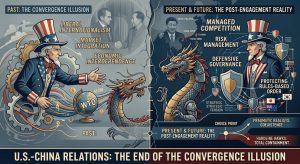
For nearly four decades following President Richard Nixon’s historic 1972 visit to Beijing, American foreign policy toward China operated under a foundational doctrine known as “constructive engagement.” The central thesis of this strategy—often termed the Convergence Hypothesis—was straightforward: by integrating China into the global economic architecture, granting it access to international institutions like the World Trade Organization, and fostering economic interdependence, the United States could encourage domestic economic liberalization that would inevitably lead to political democratization.
By the late 2010s, this policy framework collapsed. Today, foreign policy experts across the political spectrum—including Hoover Institution scholar Dr. Elizabeth Economy—agree on a stark reality: the United States has abandoned its long-standing campaign to transform or democratize China.
The Root of the Shift: Realization of Futility
The pivot in Washington was not driven by a philosophical acceptance of Beijing’s political governance, but rather by the pragmatic realization that the engagement strategy had failed to achieve its primary geopolitical objective. Instead of liberalizing, the Chinese political system evolved in the opposite direction. Following the 2008 global financial crisis and the subsequent consolidation of power under President Xi Jinping, China tightened state control, expanded internal security networks, and reinforced party authority over both the economy and civil society. Rather than acting as a solvent on single-party rule, global market integration provided the Chinese Communist Party (CCP) with the financial and technological resources to solidify its governance model.
In response, American policymakers reached a bipartisan consensus: attempting to remake a nation of 1.4 billion people with a distinct civilizational identity was fundamentally futile. As former U.S. foreign policy officials noted in influential assessments during the late 2010s, Washington had to confront a China that had taken a path contrary to Western expectations, marking the formal end of the engagement era.
From Transformation to Managed Competition
Having abandoned the objective of internal political transformation, U.S. foreign policy has pivoted from offensive political promotion to defensive strategic containment. Current American strategy centers on three primary pillars:
- Pragmatic Realism Over Systemic Change: Washington no longer measures the success of its China policy by whether Beijing adopts democratic norms, but by how effectively the U.S. can protect its own security, economic resilience, and technological edge alongside an enduring peer competitor.
- Defensive Governance: U.S. advocacy regarding human rights and governance has shifted from an effort to reform the CCP’s internal political structure toward a mechanism for enforcing export controls, imposing targeted economic sanctions, and deterring external power projection.
- Protecting the External Order: The focus of American diplomacy has moved outward—concentrating on reinforcing alliances in the Indo-Pacific, securing critical supply chains, and preventing Beijing from unilaterally altering global rules and international institutions.
The Modern Washington Consensus: Shared Diagnosis, Divided Prescriptions
While the abandonment of liberal engagement is universally accepted across Democrats, Republicans, and national security strategists, Washington remains divided on how to navigate the post-engagement era. The debate splits the foreign policy establishment into two primary camps:
- The Pragmatic Realists (Mainstream Strategy): Comprising mainstream diplomats and scholars, this group advocates for “managed competition” and peaceful coexistence. They argue that because complete economic decoupling is unviable and high-intensity military conflict must be avoided, the United States must find a way to live alongside a powerful, non-democratic China while actively deterring aggression.
- The Hardline Hawks: Conservative strategists and hardline foreign policy voices reject coexistence as insufficient. While agreeing that attempting to persuade China to democratize was naive, they contend that the CCP’s governance model poses an existential threat to the international order, arguing instead for total economic detachment, aggressive containment, and the ultimate weakening of the ruling party.
Ultimately, the evolution of U.S. policy toward China represents a fundamental transition from idealism to structural realism. Washington no longer operates under the assumption that it can alter China’s internal political destiny; instead, it is focused on managing an enduring geopolitical rivalry with an authoritarian power that is now recognized as a permanent feature of the global landscape.