
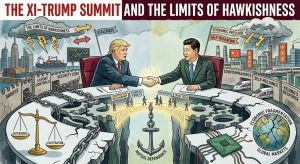
The recent Xi–Trump summit offers an important lesson about the limits of a purely hawkish approach to U.S.–China relations.
For years, Washington has increasingly treated China through a national-security lens. Tariffs, export controls, technology restrictions, investment screening and supply-chain diversification have all been justified, at least in part, by the need to counter China’s strategic rise. Beijing, in turn, has responded with its own restrictions and countermeasures.
But the summit in Washington demonstrated something that strategic competition can easily obscure: even two deeply distrustful powers still need each other enough to negotiate.
The most tangible outcome was not a grand strategic breakthrough but an extension of the existing tariff truce. The arrangement leaves difficult questions—including tariffs, Chinese purchases, rare-earth supplies and technology restrictions—unresolved, but it also prevents those disputes from immediately escalating into another broad trade confrontation.
That distinction matters.
A hawkish strategy assumes that economic pressure can improve America’s strategic position. Sometimes it can. China’s industrial subsidies, technology policies and military activities create legitimate issues that cannot simply be wished away through economic engagement.
But there is a point at which economic pressure becomes self-defeating.
The security dilemma illustrates why. Washington restricts a certain technology because it fears China’s military or strategic capabilities. Beijing interprets the restriction as containment and responds by accelerating technological self-reliance or restricting critical materials. Washington then sees that response as confirmation of the original threat. Each side’s defensive move becomes evidence for the other side’s offensive intentions.
The summit offered a temporary interruption to that cycle.
Indeed, Xi explicitly described the objective as building a “constructive China-U.S. relationship of strategic stability” and finding a way for the two major powers to coexist. Trump likewise emphasized the longstanding ties between the two peoples at the state dinner, while acknowledging that the countries represent different political systems.
The symbolism of the summit was striking. The White House state dinner brought together senior government officials and prominent American business and technology leaders, underscoring that the U.S.–China relationship is not simply a military contest. It remains deeply connected to commerce, technology, finance and global markets.
This is the contradiction Washington must confront.
If China is simultaneously America’s strategic competitor and one of the world’s most important economic partners, treating every economic relationship as a security vulnerability eventually becomes impossible.
That does not mean abandoning deterrence or overlooking genuine security risks. It means distinguishing between what must be protected and what can remain open.
Advanced military technologies may require restrictions. Sensitive supply chains may require diversification. Genuine intellectual-property disputes and unfair trade practices can be negotiated and contested.
But ordinary trade, global commerce, scientific cooperation and diplomatic communication should not automatically become casualties of strategic rivalry.
The alternative is economic fragmentation. Supply chains become more expensive. Third countries are pressured to choose sides. Global cooperation becomes harder. And resources that could be devoted to innovation and domestic competitiveness are redirected toward managing an increasingly divided global economy.
The Xi–Trump summit therefore should not be interpreted as proof that confrontation has disappeared. It has not. Reuters reported that the meeting produced limited concrete breakthroughs, while many fundamental disputes remain unresolved.
But that may actually be the more important lesson.
Great-power competition does not have to mean permanent escalation.
The strategic objective should be neither accommodation at any price nor confrontation for its own sake. It should be competitive coexistence with enforceable guardrails: compete where interests genuinely conflict, deter where security requires it, negotiate where interests overlap, and preserve economic relationships wherever they do not create unacceptable vulnerabilities.
The real measure of strategic strength is not how aggressively a country can confront its rival.
It is whether it can defend its interests without destroying the stability and prosperity those interests are ultimately meant to protect.