
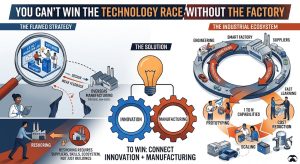
For decades, America made a powerful but ultimately flawed assumption: it could dominate the technologies of the future without maintaining the industrial capacity to build them.
The strategy seemed logical. Keep the research laboratories, universities, software companies, patents, venture capital and corporate headquarters in America. Move manufacturing overseas to reduce costs. The United States would control the high-value intellectual property while foreign factories handled the supposedly lower-value physical production.
But manufacturing is not merely the final step after innovation.
The factory is part of the innovation process itself.
By separating design from production, America weakened the feedback loop that turns an idea into a competitive product. China, meanwhile, built an industrial ecosystem where engineering, manufacturing, supply chains and infrastructure reinforce one another.
That difference is becoming increasingly important in the technology race.
Innovation Needs a Factory Floor
Hardware innovation rarely moves directly from a laboratory to mass production. It develops through continuous experimentation.
Engineers discover that a material behaves differently than expected. A component proves too expensive. A production process creates defects. A machinist discovers a better way to manufacture a part. Engineers modify the design. The factory modifies the process.
This constant interaction creates tacit knowledge—practical expertise that rarely appears in blueprints or patents.
When production moves thousands of miles away, that feedback loop becomes weaker. Engineers may retain control of the design, but the people closest to production increasingly accumulate knowledge about how to manufacture, modify and improve it.
Eventually, the innovation advantage begins migrating from the drawing board to the factory floor.
The Industrial Ecosystem Matters
The problem is even larger than the loss of individual factories.
Modern industries depend on dense networks of specialized suppliers: precision machine shops, tool-and-die makers, chemical processors, electronics manufacturers, materials suppliers and equipment specialists.
These Tier-2 and Tier-3 companies form the industrial middle.
When American manufacturers outsourced production, many of these suppliers lost their customers and disappeared. Their capabilities were not easily replaced because industrial ecosystems are cumulative. One missing supplier can make an entire production chain more expensive or slower.
China took a different path.
Over several decades, it developed enormous manufacturing clusters in which suppliers, engineers, logistics companies and final assemblers operate in close proximity. The result is not simply lower production costs.
It is faster learning.
A Chinese company can often move from prototype to supplier to production line with extraordinary speed because the supporting ecosystem is already there.
From “0 to 1” to “1 to N”
This creates an important distinction in the U.S.-China technology competition.
America remains exceptionally strong at “0 to 1”—creating new technologies, companies and scientific breakthroughs.
China has developed extraordinary capabilities in “1 to N”—taking technologies from prototype to mass production, lowering costs and deploying them at enormous scale.
Electric vehicles illustrate the point. So do batteries, solar panels, drones, robotics and other increasingly strategic technologies.
The critical question is no longer simply:
Who invented it?
It is:
Who can manufacture millions of them, improve them continuously and drive their cost down?
That is where industrial capacity becomes strategic power.
Why Reshoring Is So Difficult?
Washington now recognizes the problem. Subsidies, tariffs and industrial policies are encouraging companies to rebuild semiconductor, battery, energy and advanced-manufacturing capacity in the United States.
But a factory cannot operate in isolation.
A semiconductor fab needs specialty chemicals, precision equipment, skilled technicians and experienced process engineers. A battery plant needs materials processors, component suppliers and sophisticated logistics. An advanced robotics industry needs machine shops, electronics suppliers and precision manufacturers.
Capital can build buildings.
It cannot instantly rebuild an industrial ecosystem.
That is the central lesson of America’s manufacturing retreat.
The factory is not a low-value appendage to innovation. It is where innovation becomes scalable, affordable and commercially useful.
The United States therefore faces a fundamental strategic challenge. It has extraordinary advantages in science, software, entrepreneurship and finance. China has developed extraordinary advantages in manufacturing depth, supply-chain integration and industrial scale.
The winner of the next technological era may not be the country that produces the most brilliant prototype.
It may be the country that can build it faster, improve it continuously, reduce its cost and manufacture it at scale.
America cannot afford to choose between invention and manufacturing.
To win the technology race, America must once again learn how to do both.
Because ultimately, you can’t win the technology race without the factory.