
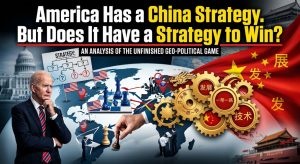
The United States does not lack a China strategy. It lacks something more important: a clear theory of victory.
Washington has assembled an impressive collection of policies aimed at countering China: semiconductor subsidies, export controls, investment restrictions, tariffs, military alliances, and partnerships with Japan, India, Australia and other nations. Together, these measures represent a serious effort to slow China’s technological advance and reduce American dependence on Chinese supply chains.
But a collection of defensive policies is not necessarily a grand strategy.
The central weakness of America’s approach is that it is often defined by what China must not be allowed to achieve rather than by what America must build to remain competitive.
Export controls can restrict China’s access to advanced chips. Tariffs can protect selected industries. Military alliances can strengthen deterrence. Industrial subsidies can encourage companies to build factories at home. But none of these measures, by themselves, solves America’s deeper problem: the erosion of the industrial ecosystem that connects invention to production.
That connection matters enormously.
The United States remains extraordinarily strong in basic research, software, finance, entrepreneurship and frontier technology. China, however, has demonstrated remarkable capacity to take technologies from the laboratory and rapidly scale them into factories, supply chains, infrastructure and mass markets.
That is the real battlefield.
The competition is not simply about who invents the next breakthrough. It is about who can move fastest from idea to prototype, prototype to factory, and factory to global deployment.
America has increasingly separated these stages. China has increasingly integrated them.
The weakness is particularly visible in trade policy. Washington wants countries to reduce their economic dependence on China, yet it has offered no comparably powerful alternative framework for economic integration across Asia. Security partnerships are important, but allies cannot be expected to choose Washington economically if China remains the more deeply integrated trading partner.
There is another problem: political discontinuity.
A strategy that can change dramatically with every administration is difficult to execute against a competitor operating with a much longer time horizon. Beijing can pursue industrial objectives for decades, continually adjusting tactics without abandoning the larger direction.
The United States needs something more durable.
A genuine grand strategy toward China should not simply attempt to contain Chinese capabilities. It should define what America intends to build over the next generation: world-class manufacturing capacity, abundant and inexpensive energy, modern infrastructure, resilient supply chains, technical education, semiconductor ecosystems, advanced robotics, artificial intelligence deployment and a stronger economic architecture with allies.
Most importantly, America must reconnect invention with execution.
The United States invented many of the technologies that transformed the modern world. But technological leadership cannot be sustained indefinitely if production ecosystems migrate elsewhere. Intellectual property may generate enormous financial value, but factories create the industrial capabilities that turn technology into economic and strategic power.
This is why the defining question of the U.S.-China competition is not simply who has the better technology.
It is who can scale technology into national power.
America does not need to become China. It does not need to abandon markets, democracy or private enterprise. But it does need to recover something it once understood instinctively: you cannot win the technology race without the factory.
The next American grand strategy should therefore be less about stopping China—and more about rebuilding America.