
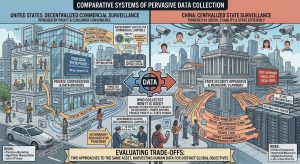
The fundamental difference between the U.S. and Chinese approaches to personal data is not whether data is collected—it is who controls it, why it is collected, and how much power individuals have to resist its use.
The United States: Commercial Surveillance
In the United States, enormous quantities of personal information are collected by technology companies, wireless carriers, internet platforms, advertisers, credit agencies, and data brokers. Much of this information is gathered for commercial purposes: profiling consumers, targeting advertising, predicting behavior, optimizing pricing, and monetizing attention.
The government can also obtain commercially held information through legal processes, national-security authorities, and, in some circumstances, purchases from data brokers. The result is a decentralized but extraordinarily extensive surveillance ecosystem in which individuals often have limited understanding of what is collected about them or how many organizations ultimately possess it.
The primary incentive is profit. Yet the consequences extend beyond advertising. Detailed behavioral profiles can influence what people see, what they buy, what prices they are offered, and potentially how institutions evaluate them. The central weakness of the American model is therefore that privacy can become a commodity: those with the resources to collect and analyze personal information acquire power over those being observed.
China: State-Integrated Surveillance
China operates a fundamentally different model. Major technology platforms, telecommunications companies, financial institutions, and other organizations function within a regulatory environment in which the state possesses extensive authority to demand information and require cooperation. Government agencies can integrate data across administrative systems, creating a much greater capacity for centralized monitoring.
The stated objectives include public security, fraud prevention, urban management, economic administration, transportation, and delivery of government services. Data integration can produce genuine administrative efficiencies and allow authorities to respond rapidly to certain social and economic problems.
But the same infrastructure creates much greater risks when political power is involved. Surveillance capabilities can support censorship, monitoring of dissent, restrictions on movement, administrative punishment, and forms of digital exclusion. Where independent institutions and judicial remedies are weak, citizens may have limited ability to challenge the government’s interpretation or use of their data.
The central weakness of the Chinese model is therefore state power: personal information can become an instrument of governance rather than merely a commercial asset.
The Deeper Problem: Data Becomes Power
It is tempting to declare one system morally superior to the other, but that comparison requires nuance. The two models are not identical, and their institutional safeguards differ substantially. The United States has constitutional protections, independent courts, civil-society organizations, and regulatory mechanisms that can constrain both corporations and government. China has also developed privacy and data-security regulations, although enforcement and political constraints remain significant.
The more useful comparison is therefore not simply “which country collects more data?” but “who possesses the power created by that data, and what prevents its abuse?”
The American danger is commercial surveillance without meaningful individual bargaining power.
The Chinese danger is state surveillance without meaningful political recourse.
In both cases, however, personal data has become a source of institutional power. The crucial question for the twenty-first century is whether societies can establish meaningful limits on that power—regardless of whether the entity exploiting the data is a corporation seeking profit or a government seeking control.
Privacy ultimately requires more than restricting data collection. It requires ensuring that those who possess information about citizens cannot easily convert that information into unchecked power over them.