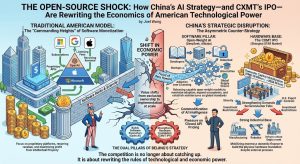
The Open-Source Shock: How China’s AI Strategy—and CXMT’s IPO—Are Rewriting the Economics of American Technological Power
by Joel Wong
The blockbuster initial public offering of ChangXin Memory Technologies (CXMT) on Shanghai’s STAR Market should be understood as more than another semiconductor financing event. Raising nearly 58 billion yuan (about US$8 billion), it demonstrated that China can now mobilize enormous domestic capital to finance strategic technologies despite years of U.S. export controls and investment restrictions. Coming on the heels of China’s rapid advances in open-weight artificial intelligence, the IPO sends a broader warning: America’s strategy of preserving technological leadership through sanctions, capital restrictions, and proprietary innovation is facing an increasingly sophisticated challenger.
For more than three decades, the United States has occupied the commanding heights of the global digital economy. American companies did not merely invent breakthrough technologies; they mastered the art of monetizing them. Microsoft licensed operating systems, Oracle sold enterprise databases, Google monetized search through advertising, Apple built premium ecosystems, and Amazon transformed cloud computing into a subscription business. The greatest profits often accrued not to those who manufactured physical products, but to those who owned the software platforms upon which the world depended.
Artificial intelligence appeared poised to extend that model. Companies such as OpenAI, Anthropic, Google, and Microsoft invested hundreds of billions of dollars in AI infrastructure, expecting frontier models to become proprietary platforms generating recurring revenue through subscriptions, enterprise licensing, and cloud APIs. Investors embraced the idea that AI would become another high-margin software industry, reinforcing America’s comparative advantage in finance, intellectual property, and digital services.
China has pursued a fundamentally different strategy.
Rather than relying exclusively on proprietary models, Chinese companies such as DeepSeek, Alibaba, Moonshot AI, and others have released increasingly capable open-weight models that developers worldwide can download, modify, and deploy. Their objective is not simply to maximize licensing revenue from each model but to maximize adoption, expand developer ecosystems, and establish Chinese AI architectures as global standards.
This approach changes the economics of artificial intelligence.
Traditional software businesses depend on scarcity. Customers pay recurring fees because access to proprietary technology is restricted. Open-weight AI weakens that scarcity. If organizations can operate highly capable models on their own infrastructure at little or no licensing cost, the premium commanded by closed APIs inevitably comes under pressure. Frontier proprietary models may retain advantages at the cutting edge, but for many commercial applications, “good enough” at one-tenth the cost becomes a compelling alternative.
The result is a structural challenge to the business assumptions underpinning much of America’s AI industry. Companies that expected sustained pricing power increasingly face competition from open ecosystems that improve through contributions from universities, startups, and developers around the world.
The implications extend well beyond corporate profits.
The United States has long derived extraordinary economic strength from controlling the world’s most valuable software platforms. Software and digital services generate exceptionally high margins while requiring relatively little physical capital once developed. They have also reinforced the dominance of American financial markets by creating technology companies with trillion-dollar valuations that attract global investment.
China’s strategy attacks this advantage indirectly.
By making advanced AI broadly available, Beijing reduces the scarcity upon which premium software rents depend. Economic value shifts away from exclusive ownership of algorithms toward implementation, integration, manufacturing, and industrial deployment. Competitive advantage increasingly belongs to those who can apply AI at scale rather than simply license it.
That shift aligns closely with China’s broader development strategy. AI is being integrated into factories, robotics, logistics networks, electric vehicles, smart cities, and industrial automation. Open-weight models lower deployment costs and accelerate adoption across the real economy. Instead of viewing AI primarily as a software product, China increasingly treats it as enabling infrastructure for national productivity.
Viewed together, DeepSeek’s open-weight models and CXMT’s successful IPO illustrate two complementary pillars of China’s technological strategy. One democratizes advanced AI, making Chinese software architectures increasingly influential around the world. The other demonstrates China’s growing ability to finance and expand its domestic semiconductor industry despite external pressure. One builds the software ecosystem; the other strengthens the hardware foundation. Together they reduce China’s dependence on foreign technology while expanding its influence over the next generation of digital infrastructure.
None of this guarantees that China’s model will prevail. American companies continue to lead many frontier AI capabilities, and proprietary models may retain important advantages in performance, security, and enterprise support. Nor does open-weight AI eliminate legitimate concerns about governance, misuse, or intellectual property.
But the strategic landscape has undeniably changed. The question is no longer simply who can build the most powerful AI model or manufacture the fastest chip. It is whether the future digital economy will be organized around proprietary platforms that generate recurring software rents or around open ecosystems that commoditize AI and shift value toward industrial execution.
If the latter proves true, the implications extend far beyond artificial intelligence. It would challenge one of the central pillars of America’s modern economic model: the ability to dominate global markets through finance, intellectual property, and high-margin software platforms. In that sense, CXMT’s IPO was more than a successful fundraising event. It was a warning shot that the competition is no longer about catching up. It is about rewriting the rules of technological and economic power.