
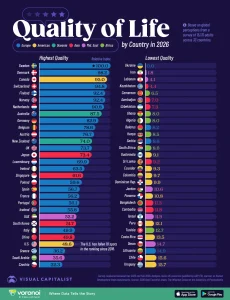
The recent findings from the Wharton School’s 2026 Best Countries Index provide a provocative lens through which to view the competing realities of middle-class life in the U.S. and China.
While the index—which ranks nations based on global perceptions of safety, healthcare, education, and institutional stability—places Sweden and Denmark at the top, it notes a significant divergence between the world’s two largest powers. China now ranks slightly higher than the U.S. in these perceived quality-of-life metrics (49.8 to 48.6), a finding that underscores the growing global sentiment that American institutional influence is eroding while China’s model of state-managed stability resonates increasingly with international observers.
Whether the average middle-class person is “better off” in China or the U.S. depends entirely on how you define “better off.” If you measure it strictly by raw purchasing power, disposable income, and material consumption, the American middle class maintains a massive lead. However, if your definition weights public safety, infrastructure, financial predictability, and basic social stability, the Chinese middle class can make a very compelling case.
Comparing the two middle-class realities requires looking at four critical pillars.
1. Purchasing Power & Material Abundance (Advantage: U.S.)
By pure numbers, the material floor of the American middle class is significantly higher.
- The Income Gap: The U.S. GDP per capita (adjusted for purchasing power parity, or PPP) sits around $85,000, compared to China’s PPP-adjusted GDP per capita of roughly $31,500. Even when accounting for China’s lower cost of living, an individual or household at the exact median of the U.S. income distribution simply has far more discretionary income.
- Consumable Goods: Goods that are priced globally—such as specialized electronics, international travel, or luxury imports—consume a much smaller slice of an American middle-class paycheck than a Chinese one.
- The Space Premium: The standard American middle-class lifestyle includes suburban square footage and multi-vehicle ownership that is structurally impossible to replicate for the vast majority of China’s 400-million-strong urban middle class, who mostly live in high-rise apartments.
2. Physical Safety & Public Infrastructure (Advantage: China)
Where the Chinese middle class feels distinctively “better off” is in the daily environment provided by public goods.
- Frictionless Cities: China’s urban middle class lives alongside world-class, hyper-modern public infrastructure. High-speed rail networks connect almost every city, subways are pristine and hyper-efficient, and ubiquitous 5G combined with seamless digital payment ecosystems makes daily logistics incredibly low-friction.
- Violent Crime: For a middle-class parent in Beijing, Shanghai, or Shenzhen, the absolute absence of gun violence, property crime, and urban decay is a massive quality-of-life benefit. Children walk alone at night with near-zero concern for physical safety—a stark contrast to the anxiety many American families feel navigating major U.S. metro centers or school safety concerns.
3. Healthcare, Education, and Systemic Debt (A Nuanced Tie)
Both systems present different versions of a middle-class trap, but the financial stress manifests differently.
- The U.S. Vulnerability: The American middle class faces catastrophic downside risks. A medical emergency or an extended period of unemployment can completely wipe out a middle-class family due to the exorbitant, opaque costs of private healthcare. Furthermore, funding higher education routinely saddles American families with decades of student debt.
- The Chinese Vulnerability: China has universal basic healthcare, but coverage for advanced or chronic illnesses is heavily limited, forcing families to maintain massive “rainy day” cash balances. Education is public and cheap, but the structural bottleneck of the Gaokao (college entrance exam) creates an environment of intense peer pressure. Middle-class families are forced to pour immense time, energy, and capital into competitive supplemental training just to keep their children from falling behind.
4. Stability, Balance, and The Future (A Dual Crisis)
In 2026, both middle classes are dealing with acute psychological burnout and a sense of precariousness, but for opposite reasons:
- The U.S. Anxiety: High interest rates and a persistent inflation hangover have made traditional middle-class milestones—specifically homeownership—increasingly out of reach for younger generations. There is a deep, prevailing fear that the next generation will be worse off than their parents.
- The China Anxiety: The Chinese middle class is facing an “involution” (neijuan) crisis. While they own their homes (with a homeownership rate over 80%), China’s multi-year real estate slump has shrunk their paper wealth. To protect their remaining capital, they are hoarding savings and facing intense workplace burnout amid a highly competitive white-collar job market.
Summary
The contrast between these two nations is now reaching a global tipping point. When the U.S. ranks 27th globally in quality-of-life perceptions—placing behind all other G7 economies—it signals that the world is no longer viewing American-style material abundance as a sufficient trade-off for systemic instability.
If you favor a high-upside, high-consumption lifestyle where you have maximal personal space, greater career flexibility, and massive purchasing power—but accept higher physical risks and financial instability—the U.S. middle class is undeniably better off. If you favor a low-downside, high-predictability lifestyle anchored by unmatched public safety, world-class infrastructure, and reliable public order—but accept smaller living spaces, lower wage ceilings, and intense societal conformity—the Chinese middle class has built a lifestyle that many of its members wouldn’t trade for the American alternative.