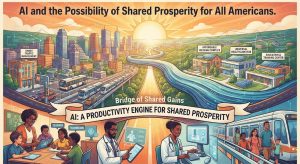
AI and the Possibility of Shared Prosperity for All Americans
Artificial intelligence is often framed as a technology that will inevitably enrich a tiny elite while further hollowing out the middle class. While this fear is rooted in decades of wage stagnation and wealth concentration, it mistakenly views AI as an autonomous force. The reality is that AI will not automatically bring prosperity to all; rather, its impact depends entirely on deliberate institutional design and the political will to distribute its gains.
The core promise of AI is a massive surge in productivity. By automating routine tasks and augmenting human decision-making, AI can lower the costs of essential services—healthcare, education, and finance—while optimizing public infrastructure. If harnessed correctly, this productivity boost can raise the standard of living, making high-quality services accessible to the broader population rather than just the wealthy.
However, without intervention, AI risks becoming a tool for rent-seeking and capital accumulation, further widening the chasm between the top 1% and the rest of the nation. To ensure this does not happen, the U.S. must shift from a “market-only” approach to treating AI as public infrastructure.
This requires three critical pillars. First, redistributive policy is essential; taxing AI-generated surpluses can fund direct support for housing, healthcare, and education, transforming economic gains into tangible middle-class security. Second, we must prioritize public-sector innovation, using AI to lower costs for essential services like diagnostic healthcare and public transit, ensuring these benefits remain available to the public. Third, we must empower workers to participate in the value chain through robust upskilling, labor protections, and shared ownership models, such as employee stock funds.
Ultimately, the trajectory of AI is a choice, not a technological destiny. If we prioritize profit-hoarding, AI will exacerbate inequality. But if we commit to a model where productivity gains are socialized through policy, AI can serve as a powerful engine for universal prosperity. The question is not what AI will do to us, but whether we will choose to design it for the common good.