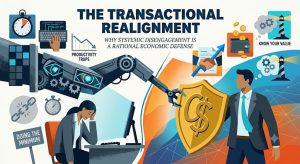
The modern employer-employee relationship is undergoing a quiet, structural breakdown. For years, corporate strategy relied on an unwritten policy: extracting “above and beyond” effort—such as out-of-hours availability, emotional investment, and informal mentorship—as a free, priced-in asset. However, a stark macroeconomic reality has set in. Faced with wage stagnation, organizational flattening, and aggressive digital monitoring, the global workforce has entered a phase of calculated, structural disengagement.
This behavior is not a sudden wave of collective laziness. Instead, it is a cold, rational optimization of a contract. In a corporate landscape defined by strict cost-cutting, employees are adopting the exact same strategy as their employers: aligning inputs precisely with compensation and providing the minimal labor necessary to fulfill their contracts while aggressively protecting their remaining time and sanity.
I. The Scale of the Quiet Collapse
This structural shift is deeply supported by empirical data, showing a profound multi-year erosion of workplace enthusiasm. According to Gallup’s State of the Global Workplace: 2026 Report, which analyzed data collected through 2025 across more than 140,000 employed respondents, global employee engagement has dropped to just 20%—its lowest level since 2020.
Global Employee Engagement Trend (2022–2025)
──────────────────────────────────────────────────────────
2022: ████████████████████████ 23%
2023: ████████████████████████ 23%
2024: ██████████████████████ 21%
2025: ████████████████████ 20% (Lowest since 2020)
──────────────────────────────────────────────────────────
Source: Gallup State of the Global Workplace: 2026 Report
This leaves a staggering 80% of the global workforce functionally unengaged or actively disengaged at work. Gallup estimates that this widespread detachment carries a massive price tag, costing the global economy approximately $10 trillion in lost productivity, or roughly 9% of global GDP.
The data also reveals a harsh psychological reality: being actively disengaged under poor management causes worse daily stress than actual unemployment. Gallup’s findings indicate that negative daily emotions remain highly elevated compared to pre-pandemic baselines, with 40% of global workers reporting that they experience a significant amount of daily stress.
II. The Taxonomy of Contractual Enforcement
Rather than a dramatic, coordinated strike—which remains economically impossible for a workforce bound by housing costs and debt—this resistance operates as an uncoordinated, individual calculation. It has created a distinct taxonomy of workplace behaviors that are essentially defensive mechanisms against exploitation:
Quiet Quitting
“Quiet quitting” is not actually quitting; it is the practice of strictly enforcing the explicit boundaries of an employment contract. This includes refusing to answer late-night communications, declining uncompensated scope increases, and keeping work strictly within paid hours. The fact that performing exactly what one is contractually paid to do was treated by corporate management as a controversial “movement” demonstrates how heavily modern business relies on free labor.
Quiet Cracking
As the hyper-fluid job market of the early 2020s tightens, workers find themselves unable to easily jump to new roles. This creates “quiet cracking”—a state where employees remain stuck in unappreciative environments, performing the bare minimum but suffering severe psychological burnout. The silent withdrawal protects corporate output from completely crashing, but it fails to shield the worker’s mental health.
The Performance of Presence
In response to widespread disengagement, corporations have invested heavily in monitoring tools, including keystroke counters, active-window trackers, and webcam checks. This has triggered an absurd, resource-heavy technological arms race:
[Corporate Tracking Tools] ──> Monitor keystrokes, webcams, and active time
│
▼ (Forces behavior shift)
[Employee Task Masking] ──> Deploy mouse jigglers, automated emails, and theater
│
▼ (Systemic Result)
[The Metric Illusion] ──> Flawless dashboard metrics masking hollowed-out value
To survive this surveillance, workers have mastered task masking—the performance of productivity theater. Utilizing hardware like mouse jigglers or software to fake background activity, employees generate the illusion of constant work. This reveals a massive execution gap: corporate dashboards show perfect activity metrics, while actual innovative capacity and genuine value production drop significantly.
III. The Evaporation of Unpriced Values
The long-term threat to corporate stability is not a sudden halt in basic services, but rather a slow, gray erosion of quality. Modern corporate margins are structurally dependent on a massive buffer of unpriced human labor. This includes:
- The senior engineer who informally mentors junior staff without a title change.
- The employee who spends personal weekend hours refining a presentation out of pride in craftsmanship.
- The coordinator who absorbs a manager’s organizational anxiety to keep a team functional.
Because these behaviors were historically given freely out of a desire for connection or career advancement, companies priced them into their models at zero cost. However, as organizations systematically flatten their structures—Gallup noted that manager engagement plummeted from 31% to 22% between 2022 and 2025—the institutional support required to foster genuine engagement has disappeared.
When workers treat employment as a pure mathematical trade and withdraw these unpriced extras, the corporate machine keeps running, but the texture changes. Software backlogs grow, customer service becomes completely rigid and unyielding, and institutional knowledge simply evaporates.
IV. Conclusion: An Inevitable Mathematical Rebalancing
The narrative that declining engagement is a personal moral failing or a lack of motivation misses the structural economic point. Workplace engagement is an economic transaction. It requires an appropriate price. When an organization cuts bonuses, freezes salary growth, and increases tracking, it reveals its clear preference for transactional optimization. It is entirely logical for the other party to the deal—the worker—to respond in kind.
For the modern professional, this environment requires a clear, practical approach to personal sovereignty:
- Strict Transactional Auditing: View employment as a bounded exchange of specific skills and time for compensation and career trajectory.
- Explicit Scope Management: Address scope creep directly and professionally. If a role expands, it must be met with an immediate, documented request for an adjusted title or higher compensation.
- Energy Conservation: If a contract cannot be renegotiated fairly, the most rational economic defense is to execute a controlled withdrawal of extra effort, saving your true innovative thinking, passion, and energy for your personal life, independent consulting, or private ventures.
The era of extracting unpriced hustle through corporate platitudes is coming to an end. The future belongs to organizations that treat human engagement as a premium asset requiring a premium price, and to individuals who protect their labor as a precise economic asset rather than an emotional identity.
References
- Gallup. (2026). State of the Global Workplace: 2026 Report. Washington, D.C.: Gallup Note: Data gathered globally from January–December 2025.
- Gallup. (2026). Global Indicator: Employee Engagement Trends. Retrieved July 2026, from Gallup Workplace Insights.
- Oxford University Workplace Wellbeing Research Institute. (2024/2025). Evaluation of Individual-Level Workplace Wellbeing Interventions. Oxford: Oxford Press.