
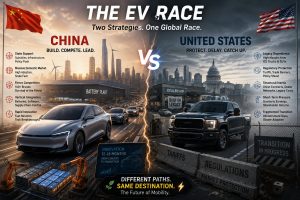
The global electric vehicle (EV) race reflects two distinct approaches to industrial development. It is broadly accurate to say that China’s EV industry was forged through intense domestic competition, while U.S. legacy automakers have relied more on regulatory protection. However, the reality is more nuanced. Both countries use government policy—but they use it differently.
China’s EV industry did not emerge from a pure free market. Beijing initially accelerated development through consumer subsidies, tax incentives, low-cost financing, charging infrastructure, and preferential licensing policies. These measures created the world’s largest EV market and encouraged hundreds of companies to enter the industry.
Once the market reached scale, government support gradually declined, allowing fierce competition to determine the winners. More than 100 EV brands competed in what became one of the world’s toughest automotive markets. Companies that survived—such as BYD, Geely, SAIC, and Chery—did so by reducing costs, integrating battery production, shortening product development cycles, and continuously improving technology. Many weaker firms disappeared through bankruptcy or consolidation. Government support created the industry; market competition strengthened it.
The United States faces a different challenge. Legacy automakers earn much of their profits from pickup trucks and SUVs powered by internal combustion engines. Shifting billions of dollars toward EV platforms risks undermining those profitable businesses. At the same time, manufacturers must manage union contracts, dealer franchise systems, legacy factories, and shareholder expectations for steady quarterly earnings.
Trade barriers, including tariffs on Chinese EVs, provide domestic automakers with additional time to adapt. While these measures may slow foreign competition, they cannot substitute for innovation or manufacturing excellence. Long-term competitiveness depends on producing vehicles that consumers choose because they are better—not because competitors are excluded.
Tesla demonstrates that the United States remains capable of building globally competitive EVs. Unlike traditional automakers, Tesla was not constrained by legacy internal combustion businesses or dealer networks. It pioneered software-defined vehicles, advanced battery manufacturing, direct sales, and large-scale production. Tesla’s success suggests that America’s challenge is less about technological capability than about transforming established business models.
The key difference lies in how each country uses industrial policy. China generally uses government support to build new industries before exposing them to intense domestic competition. The United States has more often used policy to protect existing industries during periods of technological transition.
Neither model is perfect. China’s strategy has created world-class manufacturing capabilities but has also produced overcapacity and brutal price competition. The American model has generated extraordinary innovation but has often struggled to translate technological leadership into manufacturing dominance.
Ultimately, the EV race is not simply a story of competition versus protectionism. It is a story of different strategic priorities. China has largely used policy to create competition and industrial capacity, while the United States has often used policy to preserve existing strengths during economic transition. Protection can buy time, but lasting competitiveness ultimately depends on innovation, efficient manufacturing, and the willingness to adapt to rapidly changing markets.