
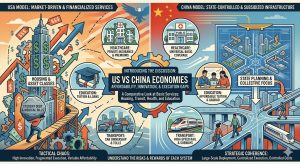
The economic structures of the U.S. and China are essentially mirror opposites, meaning their greatest vulnerabilities are exactly what the other system handles best. The exchange of lessons comes down to balancing the benefits of long-term planning with the realities of market feedback.
Here is a breakdown of what each system can learn from the other.
What the U.S. Can Learn: Closing the Execution Gap
- Strategic Coherence in Execution
The U.S. excels at ideological innovation but severely struggles with physical deployment. Fragmented local governance, regulatory gridlock, and election-cycle politics create a massive “Execution Gap.” It can take a decade simply to permit a power line or a transit link. China’s centralized model provides the Strategic Coherence necessary to mobilize capital, land, and labor rapidly, allowing it to complete complex, multi-decade projects and dominate entire supply chains (like solar and electric vehicles).
- Treating Basic Services as Economic Infrastructure
When a nation monetizes basic living requirements, it degrades its own human capital. China broadly treats mass transit, heavy industry, and basic education as foundational infrastructure necessary to maintain a productive workforce. The U.S. could stabilize its middle class by shifting away from treating services like higher education as a debt-funded consumer product, and instead viewing education as critical economic infrastructure.
- Sustained Industrial Policy
China’s progression from “Made in China 2025” to a more pervasive, next-generation industrial strategy demonstrates a commitment to incubating critical technologies regardless of short-term profitability. While the U.S. has recently embraced industrial policy (e.g., the CHIPS Act), it must learn to maintain that commitment across multiple political administrations to effectively rebuild domestic manufacturing bases.
What China Can Learn: The Power of Tactical Chaos
- Market Feedback as an Immune System
The greatest flaw in China’s Strategic Coherence is the systemic misallocation of capital. Because projects are often funded by state directives and local government quotas rather than actual consumer demand, the result is massive overcapacity—half-vacant industrial parks, “ghost cities,” and crushing municipal debt. The U.S. market’s “Tactical Chaos” is ruthless; capital flees unprofitable ventures quickly. This acts as a necessary check against building without demand.
- Fostering the Civilizational Source Code for Innovation
True, disruptive innovation rarely comes from state planning; it emerges from decentralized trial-and-error. The U.S. ecosystem tolerates high rates of failure, rewards unorthodox thinking, and relies on an open environment to attract global talent. As China tightens internal controls and focuses heavily on state security, it risks repeating the historical mistakes of the Qing Dynasty—becoming overly bureaucratic, inward-looking, and ultimately stifling the ground-up creativity required to spark the next technological revolution.
- Building a Consumer-Driven Economy
The U.S. economy is anchored by massive domestic consumption, making it highly resilient to external trade shocks. China remains structurally dependent on manufacturing and exports. To escape the middle-income trap and survive global economic decoupling, China must learn to stimulate domestic demand. This requires building a social safety net robust enough that citizens stop hoarding their income to self-insure against healthcare or retirement costs, and actually begin to spend.
The Synthesis
| Lesson Domain | What the U.S. Needs | What China Needs |
| Governance | Multi-decade Strategic Coherence | Decentralized Tactical Chaos |
| Capital Allocation | Willpower to fund physical infrastructure at scale | Market feedback to halt severe overcapacity |
| The Middle Class | Treating education and transit as public infrastructure | Building a safety net to boost domestic consumption |
| Innovation | Long-term, targeted industrial policy | Fostering open, bottom-up disruptive creativity |
Ian Bremmer Explains: What the US can learn from China’s infrastructure boom
This video provides a concise breakdown of how coordinated investment built China’s physical infrastructure, while warning that state-directed spending without market feedback leads to massive debt and overcapacity.