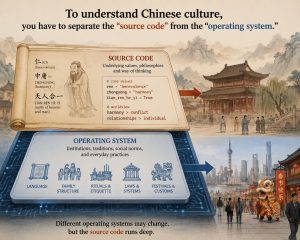
Chinese culture is often described as one of the world’s oldest continuous civilizations, but it has never been static. A useful way to think about China is that its institutions, technologies, and social practices have changed dramatically, while some deep cultural values and patterns of thought have shown remarkable continuity.
The operating system—how people dress, work, trade, and organize their daily lives—has undergone some of the most radical rewrites in human history. But the source code—the foundational assumptions about how the universe, society, and human relationships work—has remained remarkably untouched for thousands of years.
Here is a breakdown of what has stayed anchored and what has adapted.
The Immovable Core: What Has Not Changed
These are the civilizational anchors. Even when dynasties fell or revolutions attempted to eradicate the past, the culture eventually snapped back to these default settings.
- The Written Script (Hanzi): As the documentary noted, the Chinese writing system is the ultimate cultural glue. Because it is logographic (symbols represent meaning, not just sound), it transcends phonetic changes. A modern reader can look at a 2,000-year-old Han dynasty stele and understand the core meaning. It prevents the past from ever truly being lost.
- The Primacy of the Collective (Family and State): Western culture is built on the atomic unit of the individual. Chinese culture is built on the atomic unit of the network—historically the family, and by extension, the state. The concept of Xiao (filial piety) remains the bedrock moral instinct. Your achievements belong to your lineage, and your failures disgrace it.
- The Fear of Chaos (Luan) and the Ideal of Unity: China’s geography and history dictate that divided power means famine, flooded rivers, and war. Therefore, a strong, centralized, unified authority (Da Yitong) is viewed not just as a political preference, but as a moral necessity. The overriding cultural anxiety is a fear of luan (chaos).
- Meritocracy over Aristocracy: While early China had nobles, for the last 1,400 years, the culture has believed that status should be earned through rigorous testing, not bloodline. The ancient Imperial Examination (Keju) system trained the cultural reflex that intense study is the only legitimate path to power and security.
The Fluid Surface: What Has Changed
Chinese culture survives by being fiercely pragmatic. It will ruthlessly discard or adapt traditions if they no longer serve the survival or prosperity of the whole.
- The Status of the Merchant: For 2,000 years of imperial history, merchants were viewed as the lowest social class—parasites who produced nothing and merely moved goods around. Agrarian farmers and scholar-officials were at the top. Today, that hierarchy is completely inverted. China has embraced a fiercely mercantile and entrepreneurial culture, elevating tech founders and industrialists to modern cultural heroes.
- Family Structure and Gender Roles: For centuries, the ideal was a massive, multi-generational patriarchal compound living under one roof. The 20th century violently dismantled this. The Communist revolution aggressively pushed women into the workforce (“Women hold up half the sky”), and rapid urbanization (combined with the later One-Child Policy) shrunk the family down to an intensely focused, modern nuclear unit.
- Spiritual Syncretism: China is culturally agnostic in the sense that it rarely fights holy wars over exclusive truth. When Buddhism arrived from India via the Silk Road, it wasn’t rejected; it was heavily adapted, stripped of its ascetic extremes, and blended with native Daoism and Confucianism. Modern China applies this same syncretism to economics—blending Marxist state control with hyper-capitalist market mechanisms.
The Evolution of Core Pillars
| Cultural Pillar | Historical Form | Modern Adaptation |
|---|---|---|
| Social Mobility | Keju (Imperial Exams testing Confucian classics) | Gaokao (Fiercely competitive university entrance exams) |
| Governance | The Emperor and the Mandate of Heaven | The Vanguard Party and performance-based legitimacy |
| Global Posture | The “Middle Kingdom” (Center of the world, awaiting tribute) | The “Great Rejuvenation” (Aggressive global integration and infrastructure building) |
Key insight: Chinese culture does not view “modernization” and “Westernization” as the same thing. It is entirely willing to adopt foreign technology, capitalist markets, or modern fashion, but it uses them to reinforce its own traditional source code—building a stronger center and elevating the collective.