
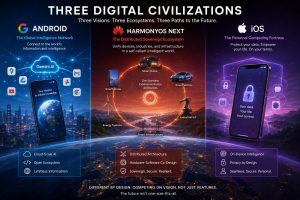
Android, iOS, and the Rise of HarmonyOS NEXT
For more than a decade, the global technology industry operated within a relatively stable duopoly. Consumers largely chose between two digital ecosystems: Google’s expansive and interconnected Android platform or Apple’s tightly integrated iOS environment.
That era is ending.
A new technological order is emerging—one defined not by two competing platforms, but by three distinct digital ecosystems. Android, iOS, and Huawei’s HarmonyOS NEXT increasingly represent different engineering philosophies, economic models, and visions for the future of computing.
These are no longer merely mobile operating systems. They are competing answers to a fundamental question of the twenty-first century:
How should billions of people interact with intelligent technology?
Android: The Global Intelligence Network
Google’s Android ecosystem remains rooted in the philosophy that shaped the modern internet: openness, connectivity, and information access.
Google’s long-term mission has always been to organize the world’s information. In the AI era, that mission is evolving into something even larger—the creation of a globally distributed intelligence layer powered by cloud computing and large-scale AI systems.
                  ┌───────────────────────┐
                  │   Gemini AI Cloud     │
                  └───────────┬───────────┘
                              │
         ┌────────────────────┼────────────────────┐
         ▼                    ▼                    ▼
   [Pixel / Samsung]   [Xiaomi / Oppo]      [Smart TV / Auto]
Within this model, the smartphone is not the destination. It is simply an access point.
Android increasingly functions as a gateway to Google’s cloud infrastructure, where AI systems can search, reason, summarize, and perform actions across multiple services simultaneously. Traditional app boundaries are gradually being dissolved as AI agents become capable of operating across platforms on behalf of users.
Strategic Advantages
- Unmatched cloud-scale AI capabilities
- Deep integration with the global internet ecosystem
- Hardware diversity spanning every price tier
- Rapid innovation driven by a decentralized device ecosystem
Strategic Challenges
- Dependence on high-bandwidth cloud infrastructure
- Persistent privacy concerns associated with data-driven business models
- Device fragmentation across manufacturers and software versions
The Android Vision
Google’s vision is the creation of a globally connected intelligence network—an AI layer capable of assisting users across virtually every digital activity without being constrained by the limits of local hardware.
iOS: The Personal Computing Fortress
Apple approaches the future from nearly the opposite direction.
Where Google prioritizes connectivity and scale, Apple prioritizes privacy, trust, and vertical integration.
   ┌─────────────────────────────────────────────────┐
   │                  iOS FORTRESS                   │
   │  ┌───────────────────────┐   ┌───────────────┐  │
   │  │   Apple Silicon NPU   │ ──► Private Cloud │  │
   │  │ (On-Device Local AI)  │   │   Compute     │  │
   │  └───────────────────────┘   └───────────────┘  │
   └─────────────────────────────────────────────────┘
The iPhone is designed as a secure personal computing environment.
Apple Intelligence reflects this philosophy. Whenever possible, AI workloads are processed directly on-device using Apple Silicon. When cloud resources become necessary, Apple routes requests through its Private Cloud Compute architecture, designed to minimize data exposure and preserve user privacy.
Rather than maximizing data collection, Apple seeks to maximize user confidence.
Strategic Advantages
- Industry-leading privacy and security standards
- Exceptional hardware-software optimization
- Strong brand loyalty and ecosystem retention
- Consistent user experience across devices
Strategic Challenges
- Premium pricing across the ecosystem
- Limited customization compared with Android
- More constrained AI models relative to large cloud-based systems
The iOS Vision
Apple’s objective is to create technology that is deeply intelligent while preserving personal sovereignty. Intelligence should serve the user without requiring the user to surrender control of their data.
HarmonyOS NEXT: The Distributed Sovereign Ecosystem
Western discussions of Huawei often focus narrowly on smartphones. Yet evaluating HarmonyOS NEXT as simply another mobile operating system misses its broader strategic ambition.
HarmonyOS NEXT is designed as a distributed operating environment rather than a phone-centric platform.
By removing legacy Android compatibility layers and building around a microkernel architecture, Huawei is attempting to create a unified software fabric capable of spanning multiple categories of connected devices.
                   ┌───────────────────────┐
                   │   HarmonyOS Kernel    │
                   └───────────┬───────────┘
                               │
         ┌─────────────────────┼─────────────────────┐
         ▼                     ▼                     ▼
   [Smartphones]       [Electric Vehicles]   [Industrial IoT]
 (Mate/Pura Series)      (Stelato/Aito)     (Energy/Smart Grid)
In this framework, smartphones, vehicles, industrial systems, energy networks, wearables, and smart devices operate as interconnected nodes within a common ecosystem.
Applications and services are designed to move seamlessly across devices rather than remaining confined to a single screen.
Strategic Advantages
- Deep integration across diverse device categories
- Efficient hardware-software coordination
- Reduced dependence on foreign software ecosystems
- Architecture designed for large-scale machine connectivity
Strategic Challenges
- Limited adoption in North America and much of Western Europe
- Smaller international developer community
- Dependence on expanding ecosystem support beyond China
The HarmonyOS Vision
Huawei’s objective is not merely to compete in smartphones. It is to build a self-sustaining digital ecosystem capable of connecting consumers, vehicles, infrastructure, industrial systems, and AI services within a unified technological framework.
The Global South and the Infrastructure Strategy
Understanding HarmonyOS NEXT requires looking beyond traditional consumer electronics markets.
Technology leadership in the coming decades may be influenced as much by infrastructure deployment as by smartphone market share.
Chinese firms have established substantial positions across several strategic sectors:
| Sector | Global Footprint and Deployment Mechanism |
|---|---|
| Electric Vehicles & Automotive Technology | Smart cockpits, advanced driver-assistance systems, and localized manufacturing networks across emerging markets |
| Telecommunications | 5G and 5.5G infrastructure deployments throughout parts of Africa, Asia, and Latin America |
| Smart Infrastructure | Port automation, smart mining, renewable energy systems, and intelligent logistics networks |
This creates a potential pathway for ecosystem expansion.
As Chinese companies export electric vehicles, telecommunications equipment, energy systems, and industrial infrastructure, HarmonyOS-compatible software environments may accompany those deployments.
From this perspective, the strategic question is not whether consumers in California switch from iPhones to Huawei smartphones.
The larger question is whether the digital and physical infrastructure of rapidly growing economies becomes increasingly integrated with Chinese technology platforms.
Three Models of Digital Civilization
At its core, the competition among Android, iOS, and HarmonyOS NEXT reflects three different philosophies about the future of computing.
       ┌───────────────────────────────────────────────────────┐
       │             THE THREE DIGITAL MODELS                  │
       ├───────────────────────────────────────────────────────┤
       │                                                       │
       │  ANDROID: Global Intelligence                         │
       │  • Cloud-driven                                       │
       │  • Open ecosystem                                     │
       │  • Information-centric                                │
       │                                                       │
       │  iOS: Personal Sovereignty                            │
       │  • Device-centric                                     │
       │  • Privacy-first                                      │
       │  • Vertically integrated                              │
       │                                                       │
       │  HARMONYOS NEXT: Ecosystem Sovereignty                │
       │  • Distributed architecture                           │
       │  • Multi-device integration                           │
       │  • Infrastructure-centric                             │
       │                                                       │
       └───────────────────────────────────────────────────────┘
Android seeks to build a global intelligence network powered by cloud AI.
iOS seeks to create a trusted personal computing environment where intelligence remains under user control.
HarmonyOS NEXT seeks to extend computing beyond personal devices and into transportation systems, industrial networks, and national infrastructure.
Conclusion: Beyond the Smartphone Wars
The smartphone battles of the 2010s were largely contests for consumer attention and market share.
The competition now unfolding is considerably broader.
Google is building a planetary-scale cognitive cloud. Apple is reinforcing a premium, privacy-centric computing ecosystem. Huawei is pursuing a distributed digital-industrial platform designed to span devices, vehicles, infrastructure, and AI systems.
The future of global technology will likely be shaped not simply by who sells the most smartphones, but by which architectural model proves most adaptable to a world increasingly defined by artificial intelligence, autonomous systems, electrified transportation, and the economic rise of the Global South.
The coming decade may reveal that the most important technology competition is no longer between products—but between fundamentally different visions of how digital civilization itself should be organized.