
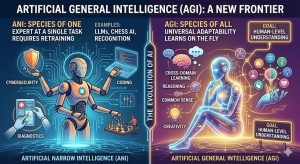
Artificial General Intelligence (AGI) is the “holy grail” of computer science—a theoretical form of AI that can understand, learn, and apply knowledge across any intellectual task, exactly like a human being.
While the AI we use today (like ChatGPT or Google Gemini) is incredibly powerful, it is technically classified as Artificial Narrow Intelligence (ANI). It is specialized for specific tasks, even if those tasks (like writing or coding) seem very broad.
What Defines AGI?
Unlike current systems, a true AGI would possess:
- Cross-Domain Learning: The ability to learn a new skill (like playing a new instrument or diagnosing a disease) without being specifically programmed for it.
- Common Sense Reasoning: A deep understanding of how the physical and social world works (e.g., knowing that if you drop a glass, it will likely break).
- Transfer Learning: Taking a concept learned in one area (like strategy in a board game) and applying it to a completely different area (like business management).
- Autonomy: The ability to set its own goals and solve problems in unfamiliar environments without human prompts.
Is it Being Achieved?
The answer depends on who you ask. As of May 2026, the field is divided into three main schools of thought:
1. The “We Are Almost There” View
Some researchers, including teams at Google DeepMind and OpenAI, argue we are seeing “sparks” of AGI. They use frameworks to track progress, such as:
- Level 1 (Emerging): Current Large Language Models (LLMs) that can perform a wide range of tasks but still hallucinate or fail at complex logic.
- Level 2 (Competent): Systems that outperform 50% of skilled adults in most non-physical tasks. Some experts at UC San Diego recently argued that since current models can pass the Turing Test and solve PhD-level problems, they already exhibit a form of “general” competence.
2. The “Missing Piece” View
Many computer scientists believe we have hit a plateau. They argue that simply adding more data and computing power won’t lead to AGI. To get there, we may need:
- Embodied Cognition: AI that lives in a physical body (robotics) to learn through “senses” rather than just text.
- World Models: AI that doesn’t just predict the next word in a sentence but actually understands the underlying physics and logic of reality.
3. The “Decades Away” View
Skeptics point out that today’s AI still lacks “true” understanding. It functions through sophisticated pattern matching rather than conscious reasoning. They argue that until an AI can demonstrate genuine creativity, emotional intelligence, and 100% reliability in high-stakes environments, AGI remains a fantasy.
Summary Table: AI vs. AGI
| Feature | Narrow AI (Current) | AGI (Theoretical) |
|---|---|---|
| Scope | Specific (e.g., Language, Chess) | Universal (Any human task) |
| Adaptability | Requires retraining for new tasks | Learns on the fly |
| Reasoning | Pattern matching/Statistical | Abstract logic & Common sense |
| Example | GPT-4o, AlphaGo, Siri | A digital entity that can “think” |
Whether AGI arrives in two years or fifty, the focus has shifted from “if” to “how” we can ensure such a system remains safe and aligned with human values.