
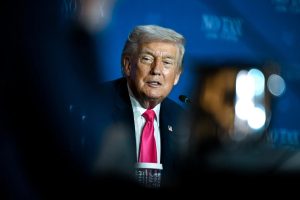
President Trump posted the transcript on his Truth Social account on Wednesday night. Credit…Kenny Holston/The New York Times
The New York Times article from April 23, 2026, details a significant diplomatic and social rift caused by President Trump’s recent endorsement of highly controversial rhetoric regarding legal and birthright citizenship, specifically targeting Indian and Chinese immigrants.
Summary of the Article
The report centers on President Trump’s decision to share a video and a four-page transcript from conservative podcast host Michael Savage. The shared content includes several provocative and factually disputed claims:
- “Hellhole” Comments: The post describes India as a “hellhole” and criticizes the U.S. constitutional principle of birthright citizenship, suggesting that immigrants from India and China use “anchor babies” to bring their entire extended families into the country.
- Workforce Allegations: The remarks shared by the President accuse Indian immigrants in the tech sector of exclusionary hiring practices—specifically alleging they pass over “white native-born Americans”—and claim, without evidence, that these immigrant communities lack English proficiency.
- Diplomatic Fallout: The Indian Ministry of External Affairs issued a formal condemnation, calling the remarks “uninformed, inappropriate, and in poor taste,” noting they do not align with the “mutual respect” typically defining the U.S.-India relationship.
- Domestic Backlash: Domestic advocacy groups, such as the Hindu American Foundation, and Democratic lawmakers have condemned the post as a “racist screed” that risks stoking xenophobia and endangering immigrant communities.
Commentary & Context
This development marks a sharp escalation in the administration’s “2026 Economic Shift” and its broader “Execution Gap” strategy.
- The Tension with “Education as Infrastructure”
The administration has previously framed its policies around maintaining American competitiveness. However, disparaging the very demographic—highly skilled Indian and Chinese tech professionals—that forms the backbone of the U.S. STEM workforce appears counterintuitive. This rhetoric risks accelerating “The Great Talent Flip,” where U.S. protectionism and a hostile social climate drive top-tier global talent back to China or toward emerging middle powers, effectively turning American “Recruitment Tools” into liabilities.
- Diplomatic Incoherence
While the administration has sought to “tether” middle powers to counter Chinese influence, calling a primary strategic partner like India a “hellhole” creates a “Middle Power Paradox.” It forces allies to choose between a “subservient” relationship with a volatile U.S. or seeking greater “sovereignty” through non-alignment or regional blocs. This erosion of soft power makes the “Cost of Strategic Alignment” for India increasingly high.
- Impact on the “Individual Survival Rubric”
For individuals navigating the 2026 economy, this signals a shift from purely legal/regulatory hurdles (like the $100,000 H-1B fee) to a broader “Individual Survival Rubric” where social acceptance is no longer guaranteed for legal residents. The move toward ending birthright citizenship—even if tied up in the courts—creates a “Hegemonic Sunset” atmosphere, where the foundational legal “source code” of the American model is being rewritten, leading to a sense of “Tactical Chaos.”
In short, the article highlights a moment where the administration’s focus on “Restoring the Rule of Law” in immigration has pivoted toward a more ideological and exclusionary rhetoric that may inadvertently undermine its own goals of economic dominance and strategic competition with China.