
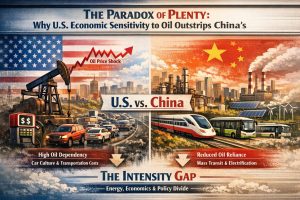
In the intricate machinery of the 2026 global economy, energy is the fundamental variable—”economic activity is energy transformed.” While conventional wisdom suggests that a nation’s vulnerability to oil supply shocks is strictly a function of its import dependency, the reality is far more nuanced. Despite the United States’ status as a leading oil producer and China’s position as the world’s largest importer, the U.S. demonstrates a surprising, heightened sensitivity to oil price volatility. This divergence, as highlighted in current geopolitical analysis, stems from profound differences in economic structure, transportation infrastructure, and policy flexibility.
The Intensity Gap
The most immediate factor is the disparity in energy intensity. The U.S. economy remains significantly more reliant on oil to power its baseline operations, with approximately 35% of its total energy consumption derived from oil. In contrast, China’s energy matrix is less oil-dependent, at roughly 18%. Because economic growth is fundamentally tied to energy inputs, an oil price shock acts as a more pervasive inflationary tax on the U.S. economy, affecting a wider array of sectors and household budgets than it does in China.
Structural Divergence in Oil Utilization
The sensitivity is further amplified by how each nation uses its oil. In the United States, the overwhelming majority of oil is diverted toward transportation. This creates a direct, elastic relationship between global oil prices and domestic economic activity. For the American consumer, an oil shock is not merely a macroeconomic statistic; it is a immediate reduction in disposable income and mobility.
China, conversely, has channeled a substantial portion of its oil intake into its massive, albeit vulnerable, petrochemical industry. More importantly, China has engaged in a deliberate, long-term strategic pivot in transportation. Through massive, state-directed investments in electrification and public transportation infrastructure, China has effectively insulated its domestic transit from the immediate whims of global oil markets.
Policy Flexibility vs. Market Dependence
This structural difference yields a crucial divergence in policy capability. In a crisis, the Chinese state possesses the mandate and the infrastructure to intervene decisively—for instance, by restricting the use of combustion engine vehicles and mandating a shift to public transit. This command-style flexibility allows Beijing to “turn down the dial” on domestic oil demand during supply dislocations.
In the United States, the reliance on private combustion-engine vehicles is deeply embedded in the social and economic fabric. There is no comparable systemic alternative to quickly absorb a massive supply contraction. Consequently, the U.S. government has limited “policy levers” to curtail oil demand without causing severe economic friction, making it more prone to the inflationary fallout of supply shocks.
The Illusion of “Energy Independence”
The common argument that the U.S. is “insulated” because it produces most of its own oil ignores the reality of globalized commodity pricing. Even as a major producer, the U.S. remains a price-taker in a global market. When a supply chain dislocation occurs—such as a disruption in the Strait of Hormuz—the resulting price spike hits the U.S. consumer with the same force as any other nation.
While the U.S. might capture some of the “left-pocket, right-pocket” benefits of domestic production, the broader structural reliance on oil for transportation means that the negative externalities—inflation, manufacturing costs, and dampened consumer spending—outweigh the gains for the average economic actor.
Conclusion: A Strategic Vulnerability
The 2026 superpower standoff, characterized by what we might term “The Execution Gap,” highlights that strategic advantage is often found in internal coherence rather than raw resource extraction. China’s aggressive de-Westernization of its supply chains and its rapid transition away from oil-intensive transportation represent a calculated hedge against the very vulnerabilities that the United States has yet to resolve.
Ultimately, the United States finds itself in a precarious position: it is an oil-producing nation that has failed to divorce its economic engine from the volatility of global oil prices, leaving it more sensitive than its primary rival, which has spent the last decade systematically building the infrastructure to resist these very pressures.