
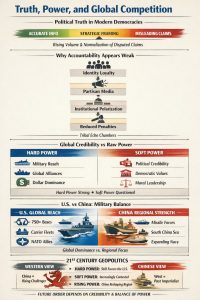
In every democracy, political truth is contested. Leaders exaggerate, opponents accuse them of deception, and the public is left to sort through competing narratives. Yet the intensity of the debate surrounding the presidency of Donald Trump reflects something deeper than ordinary political spin. It reveals a growing tension between democratic norms, partisan loyalty, and the realities of global power.
Fact-checking organizations documented an unusually large number of false or misleading statements during Trump’s first presidential term—often cited at more than 30,000 claims over four years. Political leaders have certainly misled the public before. The administration of Lyndon B. Johnson faced criticism over its portrayal of the Vietnam War, and the downfall of Richard Nixon during the Watergate scandal remains one of the most dramatic examples of presidential deception in American history.
What distinguishes the recent era, many analysts argue, is not simply the existence of misleading statements but their frequency and normalization. Disputed claims appeared not only in moments of national crisis but also in everyday political communication. Critics see this as a breakdown in long-standing political norms about truth and accountability.
Supporters view the situation very differently. For them, Trump’s blunt rhetoric was a response to what they perceive as biased media institutions and entrenched political elites. They argue that political messaging has always involved exaggeration and selective framing, and that media fact-checking often reflects ideological assumptions of its own. In that view, policy outcomes—tax cuts, judicial appointments, and immigration enforcement—matter far more than rhetorical precision.
This divide helps explain why accountability appears uneven. In a highly polarized political environment, voters often judge leaders primarily through the lens of identity and cultural alignment rather than factual disputes. Media ecosystems reinforce this dynamic, allowing competing narratives to flourish simultaneously.
Religious communities illustrate the complexity of this loyalty. Some evangelical supporters framed Trump as a “flawed vessel,” drawing parallels to Cyrus the Great, the Persian ruler described in the Book of Isaiah as a foreign king used by God to fulfill political purposes. Within that interpretation, personal shortcomings are tolerated if the leader advances certain moral or cultural priorities. Other Christians, however, argue that such reasoning risks sacrificing ethical standards for political gain.
These domestic debates have international consequences. The United States has long justified its leadership role by promoting what it calls a “rules-based order,” a framework of international institutions and norms largely shaped after World War II. When American politics appears deeply polarized or when leaders are accused of dishonesty, critics argue that the moral authority behind that system weakens.
At the same time, global influence rarely depends on credibility alone. The United States still possesses formidable structural advantages: the global role of the dollar, vast capital markets, technological innovation, and the world’s most extensive alliance network. Organizations such as NATO continue to anchor American strategic influence across multiple continents.
Militarily, the United States remains the only country capable of sustained global power projection. Its fleet of aircraft carriers, stealth aircraft, nuclear triad, and worldwide basing network give it unmatched reach. By comparison, China has rapidly expanded its military capabilities but remains primarily focused on regional defense and deterrence.
China’s strengths are increasingly concentrated in areas close to its territory, particularly around the Taiwan Strait and the South China Sea. Advanced missile systems and naval modernization have made these waters far more contested than they were two decades ago. Yet Beijing still lacks the global alliance structure and expeditionary infrastructure that underpin American military dominance.
Narratives about these developments are often shaped by national perspectives. Western commentary frequently portrays China as an emerging expansionist power, while Chinese officials emphasize a doctrine of “peaceful development.” Both narratives contain elements of truth, and both omit uncomfortable historical details.
Western powers, including the United States and European empires, built much of their global influence through overseas expansion during the nineteenth century. Conflicts such as the Opium Wars remain potent symbols of that era in Chinese historical memory. At the same time, China’s own imperial past—including territorial expansion under the Qing dynasty—is often downplayed in official narratives emphasizing national victimhood.
The lesson is not that all powers behave identically, but that geopolitical storytelling often reflects strategic interests. Nations highlight the moral failures of rivals while minimizing their own.
Ultimately, the durability of American leadership will depend on how it balances two forms of power. Hard power—economic strength, military capability, and technological innovation—still favors the United States by a considerable margin. Soft power—credibility, trust, and the ability to persuade others—has become more contested in an era of domestic polarization and rising global competitors.
History suggests that great powers rarely decline because of a single leader or a single controversy. They decline when internal divisions erode the institutions that sustain their influence. Whether the United States can renew those institutions while managing strategic competition with China will shape the international system for decades to come.