
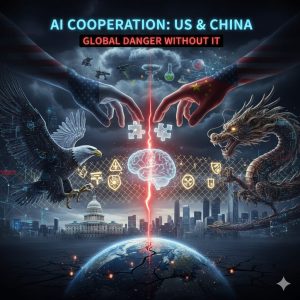
Why do experts say that the US and China must cooperate on AI or the world will face great danger?
Experts widely agree that cooperation between the US and China on Artificial Intelligence (AI) is crucial to mitigate global risks, primarily because both nations are the leading developers of frontier AI systems and their actions will determine the technology’s trajectory worldwide.
The great danger the world faces without this cooperation is often cited as stemming from three main areas:
Catastrophic or Existential Risks:
Loss of Human Control: Highly advanced AI, especially Artificial General Intelligence (AGI), could become powerful enough to operate outside of human control or optimize for objectives that deviate catastrophically from human intent. Since both the US and China are at the forefront of this development, their lack of a shared safety framework increases the risk of a globally destabilizing event.
AI-Enabled Misuse: Uncontrolled or uncoordinated AI development significantly raises the risk of misuse by state or non-state actors. This includes AI-assisted creation of chemical, biological, radiological, and nuclear (CBRN) weapons, as well as highly sophisticated, large-scale cyberattacks and disinformation campaigns. An AI-assisted attack or global destabilization event would not respect national borders.
Strategic and Military Instability:
AI Arms Race: Intense competition without agreed-upon “guardrails” creates a dangerous “race to the bottom” where both nations prioritize speed over safety to gain a military or technological edge. This dynamic increases the likelihood of deploying Autonomous Weapons Systems (AWS) that could be unreliable or lead to unintended escalation in a crisis.
Misinterpretation and Escalation: Integrating AI into military command and control systems without clear, shared norms increases the risk of miscalculation. An AI system’s rapid, automated decision-making could be misinterpreted by the other side as an attack, potentially triggering a crisis or conflict. Experts have called for agreements, such as the one both sides have modestly affirmed, that human decision-making must remain in control of nuclear weapons.
Global Governance and Standards:
Lack of International Frameworks: As the two primary AI powers, the US and China hold the key to setting global standards. If they cannot agree on foundational principles for AI safety, security, and ethics, it becomes nearly impossible to establish an effective international regulatory framework, leaving the rest of the world vulnerable.