
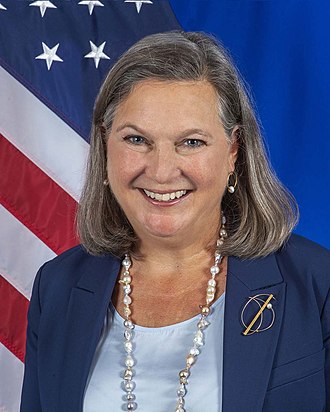
A few days ago on March 5, 2024, Victoria Nuland resigned her post as Under Secretary of State for Political Affairs and as the Biden administration’s point woman on Ukraine. As Compact’s Sohrab Ahmari has noted, Nuland’s career exemplifies the hubris and lack of accountability that characterize many Washington hawks. Determined to stuff the world’s complex realities into a simplistic good-versus-evil binary, Nuland and like-minded figures in her orbit have left a vast wreckage in the wake of their actions, stretching from Iraq to Ukraine and beyond.
The resignation of Victoria Nuland garnered significant attention for the following reasons:
- Firstly, her strong support for Ukraine and her influential role in shaping U.S. policy toward that country underscores the significance of her departure.
- Secondly, Nuland’s hawkish views on Russia, particularly in the aftermath of the annexation of Crimea in 2014, have made her a target of criticism.
- Thirdly, her loss in the internal administration battle for the position of deputy Secretary of State adds complexity to her resignation, as President Joe Biden chose Kurt Campbell instead.
- Lastly, Nuland’s leadership in confronting Putin’s invasion of Ukraine received praise from Secretary of State Antony Blinken, highlighting her three and a half decades of public service.
- Overall, her resignation holds significance due to her diplomatic role, views on Russia and Ukraine, and internal administration dynamics.
President Dwight D. Eisenhower, in his farewell address to the nation on January 17, 1961 cautioned against the undue influence of the military and the defense industry. His warning is often cited in discussions about the Military Industrial Complex.