
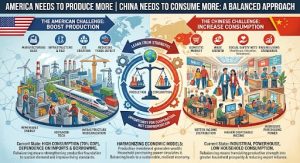
The economic differences between the United States and China reflect two contrasting development models. America has become heavily dependent on consumption, financial markets, and services, while China has prioritized manufacturing, infrastructure, investment, and exports. Both have achieved remarkable success, but both also face structural imbalances.
The American economy is driven by household consumption, which accounts for roughly 70% of GDP. Strong consumer demand has fueled entrepreneurship, innovation, and global economic growth. However, America’s growing dependence on government borrowing, financial speculation, imported goods, and asset appreciation raises questions about the sustainability of its economic model. It has become exceptionally good at generating financial wealth but has neglected parts of its manufacturing base and public infrastructure.
China faces the opposite challenge. Its enormous manufacturing capacity, infrastructure development, and investment in advanced technologies have transformed it into an industrial powerhouse. Yet household consumption remains relatively low, partly because families shoulder substantial healthcare, education, housing, and retirement expenses. High precautionary savings and insufficient household income limit domestic demand, leaving China more dependent on exports and investment to sustain growth.
However, China’s problem should not be reduced to industrial overcapacity. Its productive capacity is also a strategic asset, providing economies of scale, technological capabilities, and supply-chain advantages. The challenge is to translate that productive strength into greater household prosperity. Stronger social safety nets, better income distribution, and higher disposable incomes would encourage domestic consumption and reduce reliance on foreign markets.
Likewise, America’s problem is not simply excessive consumption. Consumer demand is an important economic strength. The deeper issue is whether its productive foundation, infrastructure, and income distribution can sustain that demand over the long term.
Ultimately, investment and consumption should not be viewed as competing economic priorities. Productive investment creates the capacity to generate wealth; household purchasing power allows that wealth to circulate throughout the economy.
America needs to produce more of what it consumes. China needs to consume more of what it produces.
Rather than declaring one economic model superior, both countries should recognize their respective weaknesses and learn from each other’s strengths. America could benefit from China’s long-term industrial planning and infrastructure development, while China could benefit from America’s stronger consumer market and household-demand dynamics.
The objective of economic development should not simply be to maximize GDP, exports, investment, or consumption. It should be to improve living standards through a sustainable balance between production, investment, wages, and consumption.
In an increasingly interconnected world, correcting these imbalances should be an opportunity for economic cooperation, not another justification for geopolitical confrontation.