
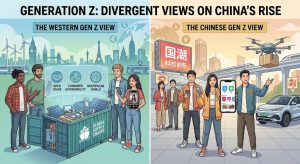
Generation Z (born roughly 1997–2012) approaches China’s global rise through a framework shaped by digital globalization, economic pragmatism, and multipolar realities. However, their outlook manifests differently depending on whether they are observing from the West or living inside China.
1. The Western Gen Z Perspective (External View)
In North America and Western Europe, younger cohorts view China’s rise less through a traditional Cold War, zero-sum lens and more as an inevitable geopolitical and economic shift.
- Pragmatism Over Threat: Western Gen Z is significantly less likely than older generations (Boomers and Gen X) to view China as an existential military threat. They view China primarily as an economic peer and global actor.
- Skepticism Toward Protectionism: Having come of age during periods of high inflation and economic uncertainty, younger Westerners tend to prioritize consumer affordability, supply chain stability, and open trade over high tariffs and economic decoupling. They also largely oppose restrictions on international academic and tech exchanges.
- Grassroots Cultural Connection: Unlike older generations whose perceptions were filtered through legacy media, Western youth directly interact with Chinese consumer culture, apps (TikTok, Xiaohongshu), and products (Temu, Shein, EV brands), demystifying daily life in China.
2. The Chinese Gen Z Perspective (Internal View)
Inside China, Gen Z exhibits deep national pride and confidence in their country’s technological and economic standing, tempered by personal anxieties over fierce domestic competition.
- Default Cultural Confidence (Guochao): Unlike older Chinese generations who viewed Western brands and governance as the gold standard, domestic Gen Z takes China’s high-tech modernization for granted. They enthusiastically champion local brands, technology, and cultural design (Guochao or the “national tide”).
- Macro-Optimism vs. Micro-Anxiety: While youth inside China maintain strong faith in the nation’s long-term geopolitical strength, AI leadership, and infrastructure, they face intense pressure in the job market. This has given rise to coping subcultures like tangping (“lying flat”) and bailan (“letting it rot”), reflecting a push back against extreme corporate overwork.
- Rejection of Western Moral Authority: Growing up amid intensifying geopolitical friction, Chinese youth view Western attempts to contain China’s tech and trade sectors not as legitimate security measures, but as hypocritical efforts to block China’s rightful global standing.
Comparative Summary
| Dimension | Western Gen Z Outlook | Chinese Gen Z Outlook |
|---|---|---|
| Core Framework | Economic peer / Multipolar competitor | Civilizational superpower / Technological leader |
| Economic Stance | Skeptical of tariffs; values affordability & open supply chains | Confident in domestic innovation and self-reliance (Guochao) |
| Information Channel | P2P digital platforms, direct consumer tech | Domestic digital ecosystem, high-tech urban environment |
| Domestic Pressures | Cost-of-living and housing affordability | Hyper-competitive job market (tangping / work-life balance) |
| View on Bilateral Friction | Favors diplomatic engagement and cooperative competition | Views Western containment efforts as hypocritical and counterproductive |