
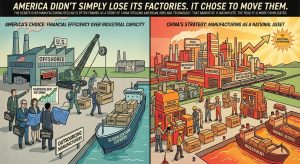
The debate over America’s manufacturing decline is often framed as a story of China stealing American jobs and technology. That narrative is incomplete. The reality is more complicated: America voluntarily moved much of its manufacturing overseas, while China deliberately used that opportunity to build an industrial powerhouse.
The two countries pursued different strategies, with very different long-term consequences.
America’s Choice: Financial Efficiency Over Industrial Capacity
Beginning in the 1980s, American corporate priorities increasingly shifted toward shareholder returns, quarterly earnings, and cost reduction. Manufacturing was often viewed as a low-margin, labor-intensive business that could be outsourced.
Three developments accelerated this transformation:
- Corporate financialization: Companies moved production overseas to reduce costs and improve profit margins, while retaining branding, intellectual property, and design.
- Globalization policy: America’s support for China’s WTO accession and Permanent Normal Trade Relations in 2000 gave businesses greater confidence to expand production in China.
- Consumer economics: American retailers and consumers embraced inexpensive imports, reinforcing the incentives to offshore manufacturing.
The underlying assumption was that America could retain its technological and financial leadership without maintaining its manufacturing foundation.
That assumption proved costly.
China’s Strategy: Manufacturing as a National Asset
China saw globalization differently. Rather than simply becoming the world’s low-cost factory, it used foreign investment, technology, and market access to develop domestic industrial capabilities.
Its strategy included:
- Technology acquisition: Joint ventures, market-access requirements, and technology transfers helped domestic companies acquire manufacturing knowledge, sometimes under pressure on foreign partners.
- Industrial policy: Government financing, infrastructure investment, subsidies, and supportive land and energy policies accelerated industrial development.
- Supply-chain integration: China developed concentrated industrial ecosystems connecting raw materials, components, engineering, assembly, and transportation.
- Technological upgrading: It moved beyond low-cost assembly into increasingly sophisticated industries, including electric vehicles, batteries, solar energy, and telecommunications.
China’s success was not simply the result of government intervention. Entrepreneurship, competition, engineering talent, economies of scale, and relentless execution were equally important.
A Mutually Beneficial Relationship with Unequal Long-Term Gains
It would be inaccurate to suggest that America gained nothing from this arrangement. American corporations earned substantial profits, consumers benefited from cheaper goods, and China gained investment, employment, and access to global markets.
But the benefits were distributed unevenly.
Wall Street and multinational corporations captured much of the immediate financial upside, while many American manufacturing communities lost jobs, skills, and economic foundations. China, meanwhile, reinvested its manufacturing gains into infrastructure, industrial capacity, and technological advancement.
The fundamental difference was one of priorities and time horizons.
The Larger Lesson: You Cannot Outsource Industrial Leadership
America did not simply outsource factories. It outsourced portions of its industrial knowledge, supplier networks, skilled workforce, and manufacturing innovation ecosystem.
Manufacturing is not merely about producing goods. It creates engineering expertise, drives product improvements, develops suppliers, and enables innovation at scale. Designing a product and actually making it are complementary capabilities, not substitutes.
America optimized for financial efficiency; China optimized for industrial capability.
Neither strategy was without flaws. China’s state-directed model has produced overcapacity, misallocation of capital, and inefficient investments. America’s market-driven model remains powerful in entrepreneurship and frontier innovation. But America’s mistake was assuming that financial markets, intellectual property, and software could indefinitely compensate for the erosion of its productive base.
The lesson is not that globalization was inherently wrong or that China should be blamed for taking advantage of it. The lesson is that national competitiveness requires both innovation and the ability to manufacture.
This has direct implications for today’s AI and technology competition. The winner will not necessarily be the country that invents the most advanced technology. It may be the country that can manufacture it affordably, integrate it into industry, and deploy it at scale.
You cannot remain a technological superpower simply by designing products, owning patents, and controlling capital. Ultimately, you must also know how to build things.