
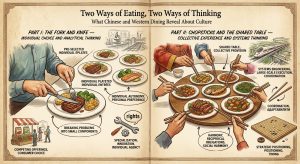
Part I: The Fork and Knife — Individual Choice and Analytical Thinking
The way people eat may seem like a small detail of everyday life, but it can reveal something about how societies organize individual choices, social relationships, and collective experiences. Consider a traditional Western dinner: a diner receives a plate with a piece of steak, fish, or a vegetarian entrée, along with selected side dishes. Armed with a fork and knife, the diner cuts the food into manageable pieces and eats at an individual pace. At a formal banquet, guests may choose their preferred entrée in advance, and each person receives a separately plated meal.
This dining tradition offers a useful metaphor for several ideas often associated with Western societies: individual autonomy, differentiation, specialization, and analytical thinking.
The individual at the center
In a typical Western banquet, the host offers a menu of alternatives and allows guests to select according to their preferences. One person chooses beef, another fish, and a third a vegetarian meal. The gathering may be communal, but the food is individualized.
This arrangement reflects an important principle in liberal thought: people have different preferences and should have room to make their own choices. The role of the organizer is to provide suitable options, while the individual decides which option best meets their needs.
The same principle appears in markets, where businesses offer competing products and consumers choose among them. It also appears in political philosophy, where individual rights and personal autonomy are central considerations.
The fork and knife offer a second metaphor. The diner uses separate tools to perform distinct tasks: the fork holds the food, while the knife cuts it. The meal is approached piece by piece. This resembles an analytical method of problem-solving: break a complex problem into smaller components, examine each one, and address them individually.
This approach has been enormously productive in science, engineering, medicine, and business. Specialization allows people to develop expertise, while decomposition makes complicated problems easier to understand and manage.
Yet the analogy has limits. Western dining is not always individualistic, and analytical thinking does not originate from the use of utensils. The connection is metaphorical, not causal. Still, the image captures a recognizable emphasis on differentiation and individual agency.
Choice, specialization, and innovation
The Western banquet also illustrates how variety can be organized through alternatives. Guests may choose among several entrées, and the kitchen prepares each meal according to the selection. The system accommodates different preferences by differentiating its offerings.
This resembles an economic model that encourages competition and innovation through diverse products and services. Companies develop specialized solutions for distinct groups of consumers, and individuals select what suits them.
The strength of this approach is flexibility. Different people have different needs, and a system that respects those differences can encourage experimentation and innovation.
But individual choice is not cost-free. Preparing separate meals can require more coordination, and a system built around individual preferences may struggle to identify and provide common goods. In society, an abundance of choices does not necessarily guarantee affordable housing, accessible healthcare, reliable infrastructure, or equal opportunity.
Nor does individual autonomy eliminate social obligations. Western banquets can be deeply communal, and Western societies depend on public institutions, shared rules, and collective action.
The deeper lesson is that individual choice and analytical specialization are powerful tools, but they do not automatically produce a well-coordinated whole.
Part II: Chopsticks and the Shared Table — Collective Experience and Systems Thinking
Now consider a traditional Chinese banquet. Instead of choosing one main course, guests sit around a table filled with multiple dishes: fish, meat, vegetables, soup, and other delicacies. The food is placed in the center, and diners use chopsticks to select what they want. Everyone can sample several dishes, and the meal develops through a shared experience.
The host does not simply offer a menu of alternatives. The host curates the entire table, selecting dishes intended to complement one another and create an experience appropriate to the occasion.
This dining tradition offers a different metaphor: common provision, relational participation, and the coordination of diverse elements within a shared system.
The shared table
In a traditional Chinese banquet, the meal is often an expression of hospitality, respect, and relationship-building. The host demonstrates care by providing an abundant and appropriate selection of food. Guests participate by sharing the dishes, offering food to one another, and enjoying the variety together.
Food is not merely an individual commodity. It is part of a social relationship.
This practice has parallels with the Confucian emphasis on relationships, reciprocal obligations, and social harmony. In this perspective, individuals are understood partly through their relationships with family, friends, colleagues, and the wider community.
The shared table does not mean that everyone eats the same thing. On the contrary, it offers many choices. The difference is that the choices are presented within a common arrangement rather than divided into separate individual meals.
Variety is achieved through sharing rather than separation.
This distinction is subtle but important. One approach accommodates diversity by giving each person a distinct option. The other accommodates diversity by placing multiple options within a common space.
Neither approach eliminates individual choice. Chinese diners still choose what to eat, just as Western diners can share food. The difference lies in how the meal is organized.
Preparation before execution
Chopsticks provide another useful metaphor. Unlike a knife, they are not designed to cut food at the table. In many Chinese dishes, ingredients are cut into small pieces before cooking, seasoned, and combined by the chef. By the time the food reaches the diner, much of the work of preparation has already been completed.
This suggests a different way of thinking about complexity. Rather than requiring each individual to break down the problem at the point of use, the system can do more work in advance so that participation becomes easier.
The same idea appears in systems engineering, manufacturing, and infrastructure planning. Components must be prepared, coordinated, and integrated before the final product can function effectively. Success depends not only on the quality of individual parts but also on how they fit together.
China’s achievements in high-speed rail, manufacturing supply chains, and large-scale infrastructure illustrate the importance of coordination and execution. These accomplishments cannot be explained by culture alone; they also depend on institutions, investment, technical capabilities, and political priorities. Nevertheless, the shared-table metaphor offers an intuitive way to understand the value of integrating many elements into a functioning whole.
Chopsticks themselves also suggest coordination. Two separate sticks must work together to grasp a piece of food. Neither stick is effective in the same way when used alone. Their usefulness comes from their coordinated movement.
This can serve as a metaphor for strategic thinking: success sometimes depends less on applying greater force than on positioning, timing, and the intelligent coordination of available resources.
Chinese strategic traditions, including Sun Tzu’s The Art of War, emphasize the importance of shaping circumstances, exploiting positional advantages, and avoiding unnecessary direct confrontation. The game of Go offers a similar illustration, with its emphasis on influence, connection, territory, and strategic positioning.
But these are traditions of thought, not automatic consequences of eating with chopsticks. Chinese history also contains direct confrontation and coercion, just as Western history contains diplomacy and systems thinking.
The common table and its limits
The Chinese banquet also reveals a tension. Sharing does not necessarily mean equality.
A host chooses the dishes and determines how the banquet is organized. Seating arrangements, serving order, and the quality of particular dishes may communicate social rank. The common table can strengthen relationships while also reinforcing hierarchy.
Likewise, a coordinated system can provide broad benefits, but it can also concentrate decision-making power. A well-organized common table is valuable only if the host understands the guests’ needs and treats them fairly.
This raises a fundamental question for society: Who decides what belongs on the common table, and how much freedom should individuals have to reject what is offered?
Collective provision can improve access to essential goods and services, but it should not become an excuse to suppress individual preferences. Conversely, individual choice can protect autonomy, but it does not eliminate the need for shared institutions and common resources.
The challenge is to combine coordination with freedom.
Conclusion: The Best Societies Need Both the Table and the Menu
The contrast between Western fork-and-knife dining and Chinese chopstick dining is not a contest between individualism and collectivism, nor between superior and inferior civilizations. It is a metaphor for two complementary ways of organizing human activity.
The fork and knife suggest differentiation, specialization, and direct intervention. The individually plated entrée illustrates the importance of personal preference and autonomy.
Chopsticks suggest coordination and adaptability, while the shared banquet illustrates how diversity can be organized within a common experience. The emphasis is not simply on what each person receives, but on how the entire table is assembled and shared.
These differences offer a useful lens for thinking about economic and political systems. A society needs the freedom to innovate, experiment, and make individual choices. It also needs the capacity to coordinate resources, build infrastructure, provide common goods, and integrate specialized capabilities into a functioning whole.
The United States has important strengths in entrepreneurship, scientific discovery, and decentralized initiative. China has demonstrated considerable strengths in manufacturing coordination, infrastructure development, and large-scale execution. Neither country possesses a monopoly on either approach, and both face serious limitations.
The ultimate goal should not be to choose between the Western menu and the Chinese banquet. It should be to build a society that offers a generous common table while preserving the freedom to choose one’s own meal.
After all, a banquet with abundant food but no freedom to choose can become oppressive. A menu offering unlimited individual choices but no shared table can leave people isolated.
The art of a good society, like the art of a good meal, lies in knowing what to share, what to coordinate, and what to leave to individual choice.