
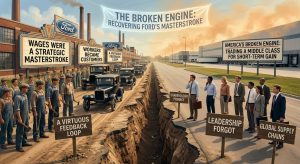
In January 1914, Henry Ford made a decision that sent shockwaves through the industrial world: he more than doubled the daily wage of his assembly line workers to $5 a day. While critics branded it an act of radical altruism or reckless folly, Ford understood something far more fundamental. High wages were not a philanthropic concession; they were a strategic masterstroke. Ford recognized that for a mass-production economy to function, the working class had to earn enough to buy the very products they built.
Today, that virtuous feedback loop—the core engine of the American middle class—lies effectively dismantled. Modern corporate America has largely unlearned Ford’s fundamental lesson, trading a sustainable domestic consumer base for the short-term dictates of financialization and global supply chains.
The unspooling of Ford’s philosophy began in earnest during the late 20th century with the rise of shareholder primacy. Under this paradigm, a corporation’s sole moral and operational duty shifted to maximizing immediate value for shareholders. Labor, once viewed as an essential partner in driving long-term productivity and purchasing power, was reclassified as merely a line-item expense to be squeezed, minimized, or exported.
At the same time, globalization uncoupled the site of production from the market of consumption. When Ford built the Model T, his domestic workforce was his domestic customer base. Today’s multinational conglomerates operate in a borderless architecture—sourcing cheap labor globally while selling to dispersed markets. The economic mandate to maintain a well-paid domestic workforce to absorb domestic output simply vanished from the boardroom calculus.
The results of this shift speak for themselves. Since the early 1970s, American worker productivity has continued its steady skyward trajectory, powered by technology, computing, and automation. Yet real median wages have remained largely stagnant when measured against corporate profits and executive compensation. To bridge the gap between flatlined paychecks and a rising cost of living, the American consumer economy became reliant on cheap credit, debt, and low-cost foreign imports—a fragile substitute for true wage-driven purchasing power.
When every enterprise seeks to minimize its own labor costs to satisfy quarterly earnings expectations, a macroeconomic crisis of demand slowly takes root. If working families lack disposable income, the broader market eventually loses the capacity to sustain the very economic activity on which corporate revenue depends.
A few notable exceptions, like Costco, still demonstrate that paying above-market wages yields lower turnover, higher productivity, and enduring customer loyalty. Yet these remain islands in an ocean of financialized management.
Henry Ford understood that high wages were not a cost to be managed down, but the ultimate catalyst of industrial expansion. Rebuilding a resilient economy will require corporate leadership to rediscover that foundational truth: a system that treats workers solely as expenses will eventually run out of customers.