
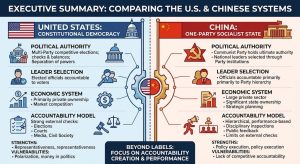
Political discussions often describe the United States as a “democracy” and China as “communist.” These labels are not entirely wrong, but they do not tell the whole story. To understand either country, we must look beyond political slogans and examine how power actually works, how leaders are selected, and how government decisions are made.
The real question is not simply what a country calls itself, but who holds power, how that power is exercised, and what limits it.
America: Democracy Influenced by Money
The United States is a constitutional republic with competitive elections, multiple political parties, an independent judiciary, and checks and balances. Citizens can vote leaders out of office, and these freedoms are important features of American democracy.
However, winning elections does not mean that ordinary citizens have equal influence over government policy.
Campaign donations, corporate lobbying, wealthy individuals, Super PACs, and special-interest groups can exert considerable influence on politicians and legislation. Court decisions, including Citizens United v. FEC (2010), have also expanded protections for independent political spending.
Research by political scientists Martin Gilens and Benjamin Page suggests that wealthy Americans and organized business interests often have greater influence over federal policy than ordinary citizens, particularly when their preferences conflict.
This does not mean American democracy is meaningless. Elections matter, and citizens can influence the government. But political influence is unequal.
America’s central contradiction is that political power formally belongs to the people, while money can give some people far more influence than others.
China: Communist Politics with a Market Economy
China presents a different picture. Politically, it is a one-party state governed by the Chinese Communist Party (CCP). It does not have competitive national elections in which opposition parties can replace the ruling party.
Economically, however, modern China is very different from the centrally planned communist economies of the past.
Since Deng Xiaoping’s economic reforms began in 1978, China has embraced markets, private businesses, foreign investment, entrepreneurship, stock markets, and international trade. Private companies play a major role in employment, innovation, and economic growth.
At the same time, the state maintains strong control over strategic industries, finance, energy, infrastructure, and national economic priorities.
China is therefore neither a traditional command economy nor a free-market economy. It combines market competition with strong state direction.
Its leadership selection system also differs from America’s electoral model.
Chinese officials often advance through years of administrative experience, managing cities, provinces, and government agencies. Their performance may be evaluated through economic development, poverty reduction, environmental protection, social stability, and implementation of national policies.
This system can reward administrative experience and policy results. However, advancement also depends on political loyalty and adherence to Party priorities. Because the CCP controls the political system, there is no independent electoral mechanism for replacing the ruling party.
China’s central contradiction is that it combines market-driven economic activity and performance-based administration with concentrated political authority and limited political competition.
Two Systems, Different Strengths and Weaknesses
| Dimension | United States | China |
| Political system | Representative democracy | One-party state |
| Leadership selection | Competitive elections | Internal Party selection |
| Economic model | Market capitalism | State-directed market economy |
| Main sources of influence | Votes, money, lobbying, media | Party authority, administrative performance, political loyalty |
| Main strength | Electoral accountability and checks | Policy continuity and coordination |
| Main weakness | Political polarization, wealth influence | Concentrated power, limited oversight |
Neither system should be understood through its most flattering description or its harshest criticism.
America has competitive elections and constitutional protections, but its political process is vulnerable to the influence of concentrated wealth. China has demonstrated considerable administrative and economic capacity, but its centralized political structure limits open political competition and independent accountability.
These differences matter. The two systems are not equivalent, and recognizing their respective strengths does not require ignoring their weaknesses.
Conclusion: Look Beyond the Labels
Calling America a “democracy” explains how its leaders are elected, but not necessarily who has the greatest influence over policy.
Calling China “communist” explains which party controls its political system, but not how its market economy actually operates.
To understand either country, we must examine how power is accumulated, how leaders are chosen, how policies are implemented, and how governments are held accountable.
This distinction is especially important in U.S.–China relations. When political labels replace serious analysis, they encourage stereotypes, exaggerate differences, and make cooperation more difficult.
A political label should be the beginning of analysis, not the end of it. The more important question is not what a country calls itself, but how its institutions work, whose interests they serve, and how effectively they deliver results for their people.