
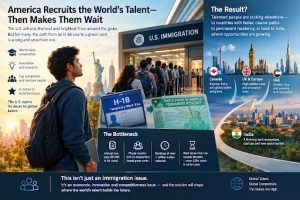
The paradox at the heart of America’s high-skilled immigration system is simple: the United States spends enormous effort attracting the world’s best technical talent, then places many of those people in a decades-long immigration queue.
The H-1B visa was designed as a temporary bridge for highly skilled workers. But for many Indian technology professionals, that bridge has become a holding pattern between temporary employment and permanent residency.
The problem is largely structural. Employment-based immigration is subject to annual numerical limits, while the law also imposes a 7% per-country limit on employment-based green cards. The result is a profound mismatch between the countries supplying high-skilled workers and the countries receiving permanent residency.
India is particularly affected because Indian nationals constitute a very large share of employment-based applicants. The consequence is not simply a longer wait at an immigration office. It can shape careers, families, entrepreneurship and, ultimately, where talented people choose to build their futures.
The Hidden Cost of “H-1B Limbo”
For an H-1B worker, temporary status can become effectively permanent employment without permanent belonging.
An approved employment petition can allow some workers caught in the green-card backlog to extend H-1B status beyond the normal six-year limit. But the underlying uncertainty remains.
Career decisions become immigration decisions.
Changing employers can involve immigration complications. Starting a company can be difficult because H-1B status is fundamentally tied to authorized employment. International travel can require navigating visa appointments and reentry requirements. And families face their own complications, particularly when children approach age 21 and can no longer remain H-4 dependents simply because their parents are still waiting.
This is more than an inconvenience. It can change the economic behavior of highly educated people.
An engineer who might otherwise become an entrepreneur may remain with a large employer. A researcher may hesitate to move institutions. A potential founder may decide that another country offers a more predictable path to permanent residence.
The Real Risk: Reverse Brain Drain
The United States has historically benefited enormously from immigrant talent. Silicon Valley, American universities, biotechnology and much of the technology sector have been built partly through the ability to attract ambitious people from around the world.
But immigration advantage is not permanent.
Canada, Britain, Europe, the Gulf states and other countries increasingly compete for the same global talent. India itself has also changed. Bengaluru, Hyderabad, Pune and other technology centers now offer opportunities that were far less attractive to returning professionals two decades ago.
The decision facing an experienced Indian engineer is therefore no longer simply:
“America or India?”
It may be:
“Where can I build a career, start a company, raise a family and know that I belong?”
That is a fundamentally different competitive equation.
The United States can tolerate losing some workers to global competitors. What it cannot easily afford is systematically losing people who have already been educated, trained and professionally developed inside the American economy.
Immigration Policy Is Economic Policy
This is why the green-card backlog should not be viewed merely as an immigration-law problem.
It is an economic-policy problem.
America has already made the investment. Universities educated these workers. Companies trained them. American communities absorbed them. Many have paid taxes, bought homes and built families. They have accumulated precisely the human capital that an advanced economy wants.
Yet the immigration system can leave these people uncertain about whether they will ultimately be allowed to remain permanently.
That creates an ironic form of self-defeating competition.
Washington worries about China, India and other countries producing more engineers and entrepreneurs. At the same time, America’s own immigration system can encourage some of those engineers and entrepreneurs to take their accumulated American experience elsewhere.
The Reform Question
Several approaches have been proposed, including eliminating or modifying per-country employment-based limits, recapturing employment visas that went unused because of administrative delays, and expanding pathways for graduates with advanced U.S. STEM degrees.
Each proposal creates distributional questions. Removing country limits, for example, could initially make the backlog substantially worse for applicants from countries that currently face little or no employment-based backlog.
That is a legitimate policy trade-off.
But the underlying problem remains: a system designed for the labor market of 1990 is struggling to manage the global technology economy of 2026.
The United States does not merely compete for chips, AI models, capital and factories. It competes for people.
And the most valuable immigrant is not necessarily the person who arrives with an H-1B visa.
It is the person who stays long enough to become a researcher, founder, engineer, investor, employer and American citizen.
America’s immigration advantage is ultimately not its ability to attract talent. It is its ability to persuade talent to build its future here.
That is the part of the system the green-card backlog puts at risk.