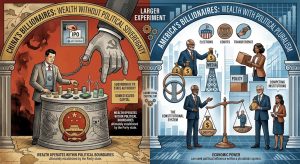
China’s billionaire class is one of the most remarkable products of the country’s economic transformation. In little more than four decades, China moved from an economy in which private enterprise was largely excluded from the formal system to one that has produced hundreds of extraordinarily wealthy entrepreneurs and globally competitive private companies.
Yet Chinese billionaires occupy a fundamentally different political position from their American counterparts. The distinction is not simply greater government intervention. It lies in the institutional relationship between economic wealth and political power.
In the United States, enormous private wealth can be used to pursue political influence through campaign contributions, independent expenditures, lobbying, media ownership, philanthropy, think tanks and advocacy organizations. But this influence operates within a pluralistic constitutional system. Billionaires compete with one another, voters retain the formal power to elect governments, courts can constrain government action, and campaign-finance and disclosure rules impose legal boundaries. Wealth can amplify a political voice, but it does not give an individual formal political authority.
China operates according to a different hierarchy: private capital can become extraordinarily wealthy, but it cannot become an independent source of political sovereignty.
Wealth Without Political Independence
China’s economic reforms gradually created space for private businesses, first through small enterprises and later through major corporations in manufacturing, technology, e-commerce, finance and consumer services. Entrepreneurs such as Jack Ma became international symbols of China’s new capitalist dynamism.
Beginning around 2020, however, Beijing sharply expanded regulatory intervention in technology, fintech, education, real estate and other sectors. The suspension of Ant Group’s IPO and the restructuring of major internet companies demonstrated that even enormously successful private corporations remained subordinate to state authority.
The objective was not simply to eliminate private enterprise. China continues to rely heavily on private companies for employment, innovation, exports and economic growth. Rather, Beijing reinforced a political boundary:
Entrepreneurs may accumulate wealth, but wealth does not entitle them to independent political power.
From Tuhao to National Entrepreneur
This helps explain the changing image of the Chinese billionaire.
During the early reform era, the tuhao symbolized conspicuous consumption and newly acquired wealth. Today, Beijing places greater emphasis on entrepreneurs who contribute to national priorities—advanced manufacturing, artificial intelligence, electric vehicles, batteries, robotics and semiconductors.
The emerging bargain is straightforward:
Create wealth. Build companies. Innovate. Support national development. But do not mistake economic success for political sovereignty.
China therefore seeks neither to abolish billionaires nor to leave them entirely autonomous. It seeks to domesticate capital—keeping it productive while preventing it from becoming a competing center of political power.
Two Different Billionaire–State Relationships
The contrast with America should not be reduced to “Chinese billionaires obey the state while American billionaires control it.” Neither description is accurate.
American billionaires possess significant opportunities to influence politics, but they operate within a system deliberately structured around competing institutions and political constituencies. Their money can help shape campaigns, public debate and policy agendas, but it cannot guarantee that government will follow their preferences. Elections can reject candidates they support, courts can block policies they favor, and other wealthy interests can oppose them.
The Chinese difference is more fundamental. The issue is not whether billionaires have influence; it is whether private wealth can become an autonomous political institution. Under China’s Party-state system, ultimate political authority does not originate from private capital and cannot be independently contested by wealthy individuals or corporations.
Thus:
America: Economic power can seek political influence within a pluralistic political system.
China: Economic power operates within political boundaries ultimately established by the Party-state.
This distinction matters because it explains why China can simultaneously encourage billionaires to build globally competitive companies and intervene aggressively when their economic activities are judged inconsistent with broader political, financial or national objectives.
The Larger Experiment
China’s billionaire experiment therefore raises a larger question:
Can a state harness the dynamism of capitalism without allowing capitalism to capture the state?
America has approached the problem by permitting substantial political autonomy for private wealth while relying on elections, courts, competing institutions and transparency rules to constrain its influence.
China has pursued the opposite institutional relationship: permitting substantial private wealth while maintaining the political primacy of the Party-state.
Neither model eliminates the connection between wealth and power. They organize that connection differently.
That is ultimately what makes China’s billionaire class distinctive. Chinese entrepreneurs can become extraordinarily wealthy, influential and globally successful—but economic power remains politically subordinate to the state.
In America, wealth can become a powerful participant in politics. In China, wealth can become powerful within the economy without becoming an independent political authority.