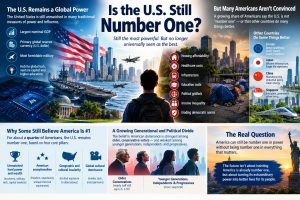
The question “Is America still number one?” increasingly produces a more complicated answer than it did a generation ago. A growing share of Americans no longer equate national power with national superiority. They recognize that the United States remains extraordinarily powerful while also acknowledging that other countries outperform it in particular areas—and sometimes in dimensions that directly affect everyday life.
The distinction is important. The United States remains unmatched in several traditional measures of global power. It possesses the world’s largest nominal economy, the dominant international currency, enormous military capabilities, leading universities, deep capital markets, and an unparalleled ecosystem of technology companies and venture investment. American companies remain at the forefront of artificial intelligence, software, aerospace, biotechnology, and other frontier industries.
By those measures, America remains a superpower.
But “number one” is no longer a straightforward conclusion when the question shifts from power to performance.
American exceptionalism has historically rested on the belief that the United States represents a unique political and economic experiment built around individual liberty, opportunity, and democratic government. For many Americans, those principles remain genuine sources of national pride. Yet exceptionalism becomes harder to sustain when citizens compare their daily experiences with those of people in other advanced economies.
Housing affordability, healthcare costs, transportation infrastructure, educational expenses, income inequality, political polarization, and institutional dysfunction have increasingly become part of the American conversation about national performance. The question is no longer simply whether America can project power abroad, but whether it can convert its enormous wealth and technological capabilities into broadly shared prosperity at home.
Geographic and cultural insulation also complicate the comparison. Americans living within a vast continental economy can go years without directly experiencing alternative models of public transportation, healthcare delivery, urban planning, education, or digital government. Meanwhile, American cultural influence creates its own psychological feedback loop. Hollywood, Silicon Valley, major technology platforms, universities, music, and popular culture remain globally influential, reinforcing the impression that America occupies the natural center of the world.
Yet cultural influence can obscure structural weaknesses.
The emerging generational divide is particularly significant. Older Americans are generally more likely to view American power and exceptionalism through the lens of the Cold War, World War II, and the postwar era, when U.S. economic and military supremacy appeared overwhelming. Younger Americans have grown up in a different environment—one characterized by globalization, China’s rise, European integration, technological disruption, expensive housing, student debt, political polarization, and highly visible shortcomings in American institutions.
They therefore tend to evaluate the country less by its historical victories and more by its current performance.
This produces a paradox: America can still be number one in power without being number one in everything that matters.
The United States remains the world’s most consequential military, financial, and technological power. But China dominates important areas of manufacturing and infrastructure. Several European and Asian countries outperform America on measures of healthcare access, public transportation, longevity, or social protections. Other countries are increasingly competitive in advanced technology, education, clean energy, and industrial policy.
The real challenge to American exceptionalism, therefore, is not necessarily that another country has already surpassed the United States across every dimension. It is that Americans are increasingly rejecting the idea that national greatness can be measured by a single scoreboard.
America’s future position will depend less on insisting that it is already number one and more on whether it can translate extraordinary national power into tangible improvements in ordinary Americans’ lives.
That may ultimately be the more meaningful definition of leadership in the twenty-first century.