
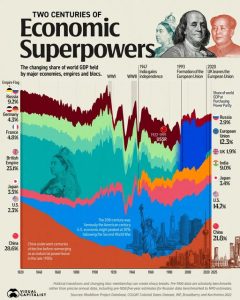
China accounted for the largest share of global GDP in 2025 when adjusted for purchasing power parity (PPP).
The U.S. share of global output peaked at 29.7% during World War II. At its 19th-century peak, the British Empire contributed nearly one-quarter of global GDP. Over the last 200 years, economic leadership has shifted from China to the British Empire, then to the United States, and increasingly back towards Asia.
The tension between Western and Chinese interpretations of China’s resurgence reflects two different conceptions of historical progress. The modern Western narrative tends to emphasize acceleration: technological breakthroughs, industrialization, capital accumulation, and institutional innovation that produce rapid changes in economic and military power. The Chinese perspective is more deeply rooted in continuity, adaptation, and civilizational endurance measured not in decades or centuries, but across millennia.
This difference matters because the modern international system is largely judged by standards that emerged after the Industrial Revolution. Beginning around 1800, Britain and later Europe and North America achieved unprecedented increases in productivity through mechanization, fossil fuels, industrial capital, and modern scientific institutions. This produced what economists call the “Great Divergence,” as Western economies dramatically increased their material output and eventually established global technological, financial, and military dominance.
Consequently, modern measures of national power—GDP, industrial production, energy consumption, technological patents, financial markets, and military capabilities—naturally emphasize the post-1800 era. These metrics are extremely useful for understanding the modern world, but they can also create a form of historical recency bias. They make the industrial era appear representative of the entire trajectory of civilization when, historically, it is an extraordinarily recent phenomenon.
China’s historical experience provides a different baseline. For much of the imperial era, China was among the world’s largest economies and a major center of technological innovation, manufacturing, commerce, and state capacity. The civil-service examination system created an unusually sophisticated mechanism for recruiting officials based on education and examination. The Grand Canal connected major economic regions on an enormous scale. Paper, printing, gunpowder, and the compass originated in China and eventually transformed societies far beyond East Asia.
China also possessed a highly developed commercial economy long before modern industrial capitalism. Chinese silk, porcelain, tea, textiles, and other manufactured goods were deeply integrated into international trade. European demand for Chinese products contributed significantly to the movement of silver into China during the early modern period.
The crucial historical rupture came in the nineteenth century. Industrialization gave Western powers capabilities that the traditional Chinese economic and political system could not match. Military technology, industrial production, financial power, and imperial institutions transformed the global balance of power. China’s subsequent weakness became associated with what Chinese historians describe as the “Century of Humiliation.”
This period, however, represents only a relatively short interval in Chinese history. It is therefore misleading to treat the nineteenth and twentieth centuries as proof that China was permanently destined to occupy a secondary position in the international system.
The contemporary resurgence of China can instead be interpreted as a restoration of capabilities that had been suppressed by a temporary but profound historical divergence. China has combined its enormous population and manufacturing base with modern science, infrastructure, education, technology, and global trade. Its rise therefore represents both modernization and historical continuity.
The deeper lesson is that neither the Western industrial model nor the Chinese civilizational model should be treated as the universal measure of progress. The Industrial Revolution transformed humanity, but it occupies only a small fraction of human history. China’s contemporary rise reminds us that global economic leadership has never been permanently assigned to one civilization.
From this longer perspective, China’s re-emergence in the twenty-first century is not simply the rise of a new power. It is also the reappearance of an old pattern: a Chinese civilization once again operating at the center of global economic, technological, and commercial affairs.