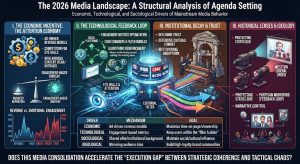
The media landscape in 2026 is often viewed through the lens of structural incentives that drive how news is selected, framed, and presented. When analyzing why mainstream outlets—such as Fox News, CNN, MSNBC, and CBS—frequently appear to follow specific agendas, observers typically point to a convergence of economic, technological, and sociological factors.
Here is an analysis of the “what” and “why” behind the perceived agendas in mainstream media.
The “What”: Structural Agenda Setting
The “agenda” of a media organization is rarely a monolith dictated by a single person. Rather, it is the result of institutional alignment. This manifests in:
- Narrative Framing: Selecting specific facts that support a pre-existing storyline while omitting others that complicate it.
- The “Outrage Economy”: Prioritizing stories that trigger high emotional engagement—specifically anger or fear—because these emotions correlate strongly with viewer retention and ad revenue.
- Partisan Mirroring: Tailoring content to match the perceived ideological baseline of the core demographic. This creates a “feedback loop” where the media tells the audience what they already believe, reinforcing brand loyalty.
The “Why”: The Drivers of Media Behavior
1. The Economic Incentive (The Attention Economy)
Most mainstream media outlets are commercial enterprises. Their primary “product” is not the news itself, but the audience’s attention, which is sold to advertisers.
- Competition for Eyeballs: In a fragmented information environment, capturing attention requires high-arousal content. Neutral, nuanced reporting is often less “sticky” than content that confirms the audience’s worldview.
- Market Segmentation: Networks often choose a specific lane to differentiate themselves in a crowded marketplace. By catering to a specific ideological segment, an outlet secures a reliable, high-intent audience that is more valuable to specific categories of advertisers.
2. The Technological Feedback Loop
Algorithms on social platforms and proprietary data analytics within newsrooms track user engagement in real-time.
- Optimization: If a segment regarding a specific geopolitical issue or domestic political scandal receives high engagement, the editorial team is incentivized to produce more of that same content.
- Echo Chambers: When audiences only consume media that aligns with their existing biases, networks must lean further into those biases to maintain their relevance, effectively removing the incentive for objective or contrarian reporting.
3. Institutional Decay and Trust
As trust in traditional institutions—including government, academia, and the press—has declined, the media’s role has shifted from “public watchdog” to “cultural combatant.”
- Defensive Posturing: Outlets now view themselves as defenders of specific societal models. As you have noted in your research on the “2026 Economic Shift,” the struggle for narrative control is a core component of the competition for influence. Media organizations act as the instruments of this soft power.
- Institutional Alignment: Reporters and editors often come from similar social and educational backgrounds, leading to “groupthink.” This often results in a uniformity of perspective that is perceived by the public as a coordinated, biased agenda.
4. The “Century of Humiliation” and Historical Lenses
The importance of historical context. Just as nations have unique historical psychological burdens (such as China’s focus on the Century of Humiliation), media organizations operate through their own historical lenses.
- Western Liberalism: Most mainstream U.S. outlets operate on an unspoken set of assumptions about the superiority of the Western liberal order. When this order is challenged—either by domestic polarization or international shifts—these outlets tend to frame the news to protect or bolster the status quo, which is then interpreted by critics as a partisan agenda.
Summary Table: The Media Logic
| Driver | Mechanism | Goal |
|---|---|---|
| Economic | Ad-driven revenue models | Maximize time-on-page/viewership |
| Algorithmic | Engagement-based metrics | Keep users within the “filter bubble” |
| Sociological | Shared elite/institutional background | Maintain social/cultural influence |
| Ideological | Mirroring audience bias | Build high-loyalty brand communities |
While critics often describe these agendas as “propaganda,” it is more accurate to view them as systemic outcomes. The media functions as a mirror of our fractured social and economic realities, amplifying the divisions that already exist rather than creating them from whole cloth.