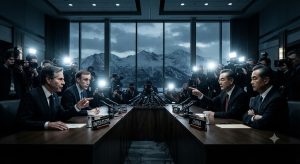
The Anchorage Summit: The Day the Illusion Ended
The March 2021 Anchorage Summit was more than another contentious diplomatic meeting. It was the moment when the strategic fiction that had underpinned four decades of U.S.–China engagement finally collapsed in full public view. For the first time since diplomatic normalization in 1979, the world’s two most powerful nations abandoned the language of cautious cooperation and openly confronted one another before a global audience.
Anchorage did not begin the new Cold War. It announced that it had already begun.
For decades, high-level U.S.–China meetings were carefully choreographed exercises in diplomatic restraint. Sharp disagreements were discussed behind closed doors, while public statements emphasized dialogue, stability, and shared interests. Even during periods of profound tension, both governments sought to preserve the appearance that competition could be managed within an overarching framework of engagement.
Anchorage shattered that convention.
The extraordinary opening exchange—broadcast live around the world—transformed what would normally have been routine diplomatic protocol into a geopolitical spectacle. Instead of reaffirming common ground, both delegations used the meeting to articulate fundamentally incompatible visions of international order. The audience was no longer the officials seated across the table; it was the world.
The summit revealed that Washington and Beijing were no longer debating individual disputes over trade, technology, or human rights. They were contesting the legitimacy of each other’s governing models and competing to define the rules of the twenty-first century.
The End of Strategic Ambiguity
Anchorage exposed a reality that had been developing for years but had never been stated so openly.
The United States approached the meeting determined to reaffirm the principles of the post-World War II international order—alliances, democratic values, human rights, and a rules-based system.
China arrived with a different message: the era in which Beijing accepted a subordinate role within an American-led order was over. Chinese officials rejected the premise that the United States possessed either the authority or the legitimacy to define global norms on behalf of the international community.
The disagreement was therefore not tactical.
It was civilizational.
Each side claimed that its political institutions, economic model, and approach to governance were better suited to lead the next phase of global development.
Anchorage transformed this philosophical divergence into explicit strategic competition.
The Public Birth of Great-Power Rivalry
Perhaps the summit’s greatest significance lies in what it communicated beyond the negotiating room.
For Washington, the meeting demonstrated that engagement alone could no longer shape China’s strategic trajectory.
For Beijing, it marked a declaration that China would no longer define its rise in relation to American expectations or approval.
Both governments emerged convinced that long-term competition—not convergence—would define the relationship.
From that point forward, diplomacy increasingly shifted from conflict resolution to strategic signaling. Summits became opportunities to reassure allies, strengthen domestic political legitimacy, deter adversaries, and shape international perceptions rather than to resolve fundamental disagreements.
The Catalyst for Systemic Competition
Anchorage accelerated trends already underway.
In Washington, bipartisan support solidified around industrial policy, semiconductor investment, export controls, supply-chain resilience, and strategic competition as enduring pillars of national policy.
In Beijing, the summit reinforced efforts to pursue technological self-reliance, reduce dependence on Western supply chains, strengthen indigenous innovation, and deepen strategic partnerships across the Global South.
The relationship evolved from one characterized primarily by economic interdependence into one increasingly defined by selective decoupling, technological rivalry, and competing visions of global governance.
Day Zero of a New Geopolitical Era
History is often remembered through moments that crystallize broader transformations already in motion: the fall of the Berlin Wall, the attacks of September 11, or the collapse of Lehman Brothers. These events did not create history in a single day, but they unmistakably revealed that one era had ended and another had begun.
The Anchorage Summit belongs in that category.
It was not the origin of U.S.–China strategic competition. It was the moment when both governments publicly acknowledged that engagement had reached its limits and that their relationship would henceforth be defined by long-term geopolitical rivalry.
In that sense, Anchorage was not simply another diplomatic meeting.
It was the ceremony that marked the end of one international era and the opening chapter of another.