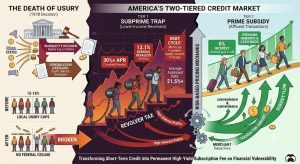
The dismantling of traditional guardrails has transformed consumer credit from a temporary liquidity safety net into a predatory, high-yield extraction mechanism that is quietly hollowing out the nation’s economic foundation.
1. The Death of Usury and Risk-Based Pricing
The structural crisis began with the 1978 Supreme Court decision Marquette v. First of Omaha, which allowed nationally chartered banks to “export” the interest rate caps of their home states across state lines.
- The Regulatory Vacuum: This effectively dismantled state-level usury laws for interstate banking, leaving the general public facing standard and penalty APRs that now routinely max out between 29.99% and 36%.
- Pricing for Default: Unshackled from price ceilings, banks abandoned traditional credit restrictions in favor of aggressive risk-based pricing. Instead of denying credit to non-prime applicants, banks began expanding credit lines to high-risk pools, mathematically offsetting default rates by charging extreme interest to the rest of the portfolio.
2. The Two-Tiered Market and the Subprime Trap
This environment split the American consumer base into a deeply fragmented, “K-shaped” split:
- The Revolver Tax: For lower-income and non-prime “revolvers,” using credit cards with average assessed rates above 21.5% to cover basic living expenses creates a state of functional negative amortization. Minimum monthly payments are entirely consumed by compounding interest, leaving the underlying principal untouched and locking families into a permanent debt loop.
- The Transactor Subsidy: Conversely, affluent “transactors” pay their balances in full every month, facing 0% interest while enjoying premium rewards and cash-back perks that are directly subsidized by merchant swipe fees and the massive interest penalties squeezed from the bottom tier.
3. The Mask of Mass Unawareness
The American public remains largely oblivious to the magnitude of this trouble due to structural shields that distort the economic reality:
- The Illusion of Averages: Mainstream financial reporting relies on top-line, aggregate data. The overall commercial bank delinquency rate sits at a deceptively healthy 2.92%, masking the fact that the 90-day serious delinquency rate for vulnerable and non-prime demographics has rocketed to a 15-year high of 13.1%.
- Atomized Financial Shame: Because carrying unmanageable debt is deeply stigmatized in American culture, individuals suffer this financial squeeze in isolation behind closed doors. This prevents the emergence of a collective public outcry or structural pushback.
- The Tactical Noise: Public attention is continuously consumed by short-term political theater and tactical chaos, leaving a massive historical blind spot regarding the long-term, systemic decay taking place underneath the status quo.
4. Why This Path Leads to Macroeconomic Drag
Relying on high-interest revolving debt to bridge the gap between stagnant wages and basic living standards is a survival mechanism running on borrowed time. This dynamic acts as a slow-motion drag on the entire U.S. economic trajectory:
- The Consumption Cliff: GDP is heavily driven by consumer spending. As a massive cohort of the population is forced to allocate an increasing share of their monthly income strictly to servicing past credit card interest, their organic discretionary spending drops to zero.
- The Credit Wall: Borrowers cannot supplement income with debt indefinitely. As consumers max out their lines and credit scores plummet, banks are forced to execute a defensive pivot—proactively tightening lending standards, freezing lines, and capping exposures to protect their portfolios from the 13.1% serious default wave.
- Systemic Fragility: When the artificial purchasing power fueled by credit cards vanishes, the economy faces a sharp consumption cliff. The systemic redistribution of wealth upward—where the survival of the lower tier is taxed to fund the perks of the upper tier—ultimately hollows out the middle class, leaving the domestic economy highly brittle and vulnerable to a sudden contraction.
The contemporary U.S. economy is operating on borrowed time, sustaining a fragile veneer of macroeconomic strength by cannibalizing its own consumer base. What appears on top-line ledgers as resilient gross domestic product (GDP) growth is, in reality, the final, high-velocity cycle of a credit-fueled engine running without oil. By transforming credit from a tool of wealth accumulation into a high-yield extraction mechanism for basic survival, the modern financial architecture has effectively financialized poverty.