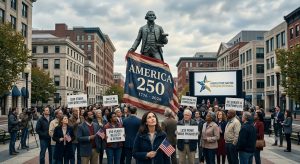
As the United States celebrates its semiquincentennial—250 years since the signing of the Declaration of Independence—the fireworks, drone shows, parades, and patriotic ceremonies tell only part of the story. Beneath the spectacle lies a nation engaged in profound self-reflection.
Unlike the Bicentennial of 1976, which largely emphasized national unity and optimism despite the lingering effects of Vietnam and Watergate, the America of 2026 reaches this milestone amid deep political polarization, economic anxiety, and declining public confidence in its institutions. The nation’s 250th birthday has become less a celebration of unquestioned triumph than an opportunity to ask a difficult question: Is America still living up to the ideals proclaimed in 1776?
Recent polling underscores this complicated mood. Gallup reports that only 33% of Americans say they are “extremely proud” to be American, the lowest level since the survey began in 2001. At the same time, the NPR/PBS News/Marist Poll found that 82% of Americans are concerned about threats to American democracy, reflecting widespread unease about the nation’s political future. Yet the picture is not entirely pessimistic. A majority of Americans still express pride in their country, and many believe its best days remain ahead. Americans have not lost faith in the nation’s ideals; rather, many question whether its institutions are fulfilling those ideals.
The contrast between America’s founding vision and today’s realities is striking. The Declaration of Independence proclaimed that “all men are created equal” and are “endowed by their Creator with certain unalienable Rights, that among these are Life, Liberty and the pursuit of Happiness.” These words remain among the most inspiring political ideals ever written. The challenge facing the United States at 250 is not whether these principles are worthy, but whether the nation is fully realizing them.
Abraham Lincoln reminded Americans during the Civil War that the United States was “conceived in Liberty, and dedicated to the proposition that all men are created equal.” He also warned that democracy depended on whether “government of the people, by the people, for the people, shall not perish from the earth.” Those words resonate powerfully today as Americans debate the health of their democratic institutions.
The country’s divisions extend beyond politics. Economic inequality has widened, housing affordability has deteriorated, healthcare costs remain burdensome for many families, and trust in government, media, and other institutions has steadily eroded. Meanwhile, the United States faces an increasingly competitive international environment that challenges assumptions about its global leadership.
Yet history suggests that moments of national anxiety are not unprecedented. The United States has survived civil war, economic depression, world wars, social upheaval, and constitutional crises. Each generation has been called upon to redefine what the American experiment means in its own era.
Perhaps that is the true significance of America’s 250th anniversary. It is not simply a celebration of the past but an invitation to shape the future. The Founders created a republic based on enduring principles, not a promise of permanent perfection. As Thomas Jefferson observed, “I am not an advocate for frequent changes in laws and constitutions. But laws and institutions must go hand in hand with the progress of the human mind.”
The semiquincentennial should therefore be viewed not as the end of a story but as the beginning of a new chapter. Fireworks illuminate the night sky for only a few moments. The harder task is renewing the civic trust, democratic institutions, and shared purpose that will determine whether the next 250 years fulfill the promise of the first.
America at 250 is both a celebration and a reckoning. Whether history remembers this anniversary as the beginning of national renewal or the continuation of national decline will depend not on commemorative speeches or patriotic displays, but on the choices Americans make after the fireworks fade.