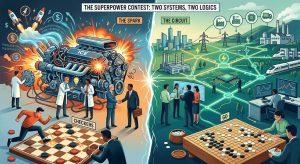
The contemporary geopolitical discourse frequently frames the United States-China rivalry through the narrow lenses of artificial intelligence milestones, semiconductor choke points, and naval tonnage. Yet, beneath these tactical flashpoints lies a profound structural collision: two distinct systemic operating systems, each governed by its own theory of power. One thrives on creative destruction and velocity; the other on central coordination and mass. To understand the trajectory of this contest, we must look past the immediate headlines and analyze the foundational metaphors that drive each superpower: the Internal Combustion Engine versus the Integrated Smart Grid, and the tactical immediacy of Checkers versus the spatial encirclement of Go.
I. The Operating Systems: Spark vs. Circuit
The American Model: The Internal Combustion Engine
The American innovation ecosystem operates much like an Internal Combustion Engine (ICE). Its structural power is generated through explosive, high-temperature bursts: venture capital booms, high-risk DARPA gambles, moonshot startups, and episodic legislative interventions. These localized “sparks” have historically produced radical technological breakthroughs, including the transistor, the internet, and generative AI. The United States remains the world’s premier ignition chamber for disruptive concepts.
However, the ICE model is inherently inefficient, cyclical, and prone to volatility. It requires vast quantities of fuel—historically in the form of cheap capital and a continuous influx of global immigrant talent—and frequently overheats, resulting in asset bubbles and deepening socioeconomic inequality. Furthermore, the system experiences structural stalls driven by political polarization and election cycles. Drastic policy pivots—oscillating between free-trade agreements and protectionist tariffs, or climate action and regulatory rollbacks—fracture long-term industrial cohesion. Consequently, while the United States excels at inventing the future, it increasingly struggles to manufacture and scale those innovations domestically.
[American ICE Model] –> High Volatility –> Radical Breakthroughs (Spark)
[Chinese Grid Model] –> High Stability –> Industrial Scaling (Circuit)
The Chinese Model: The Integrated Smart Grid
Conversely, China functions as an Integrated Smart Grid. Rather than relying on isolated explosions, Beijing synchronizes state-owned enterprises, private technology giants, provincial authorities, and five-year macroeconomic blueprints into a single unified conductor. When external macroeconomic or geopolitical shocks occur—such as trade restrictions, semiconductor export controls, or international sanctions—the grid dynamically reroutes capital and resources. Research and development subsidies are immediately redirected toward domestic import substitution, university quotas are reallocated to match critical engineering deficits, and state-backed infrastructure projects secure supply chains from raw lithium extraction to finished battery gigafactories.
The vulnerability of the Grid model lies in its centralized fragility. When the central control room miscalculates—as observed in systemic property-debt imbalances or industrial overcapacity within the solar and electric vehicle sectors—the macroeconomic repercussions reverberate across the entire network. Furthermore, innovation within this model tends to be incremental rather than revolutionary; the system inherently optimizes for systemic reliability over unguided discovery. China has demonstrated an extraordinary capacity to scale existing technologies, but it faces persistent hurdles in systematically generating entirely novel technological paradigms.
The Structural Reversion: The core of the current competition is a race toward hybridization. The United States is attempting to construct its own grid through aggressive industrial policy and near-shoring initiatives. China, meanwhile, is attempting to ignite its own spark by pouring state capital into foundational AI models and quantum computing. The ultimate advantage will belong to the state that successfully integrates both systems.
II. The Strategic Playbook: Checkers vs. Go
The divergence in structural design directly shapes how both nations execute statecraft on the global stage.
| Dimension | The U.S. Playbook (Checkers) | The Chinese Playbook (Go) |
|---|---|---|
| Primary Objective | Direct confrontation and rapid piece capture. | Spatial encirclement and long-term influence. |
| Core Metrics | Visible, short-term wins (e.g., targeted sanctions, military deployments). | Cumulative structural position (e.g., port infrastructure, trade corridors). |
| Systemic Strength | High tactical agility; rapid crisis response. | Compounding strategic positioning that is difficult to reverse. |
| Systemic Vulnerability | Reactive postures; lacks long-term structural continuity. | Susceptibility to strategic paralysis when facing asymmetric shocks. |
The Western Gambit: Checkers
Geopolitically, Washington frequently employs a strategy analogous to Checkers. The focus is trained on direct confrontation, rapid captures, and highly visible, quantifiable outcomes: the imposition of entity lists on foreign competitors, mini-lateral security alliances like AUKUS, high-profile diplomatic summits, and the deployment of carrier strike groups. This framework is highly effective for crisis management and reacting to sudden disruptions, such as military conflicts or supply-chain bottlenecks. However, it remains fundamentally reactive, measuring strategic success primarily by what it blocks rather than what it builds.
The Eastern Blueprint: Go (Weiqi)
Beijing approaches the geopolitical board through the logic of Go (Weiqi). Here, victory is achieved not through the immediate capture of adversarial pieces, but through the patient accumulation of relative advantage, the encirclement of open space, and the incremental escalation of an opponent’s operational costs. Isolated moves—a bilateral port concession in Peru, an exclusive rare-earth processing agreement, or the establishment of a regional digital currency corridor—may appear minor in isolation. Over decades, however, these positions compound into a dense network that becomes exceptionally difficult to dislodge. Beijing prioritizes defining the future parameters of the board over winning immediate tactical skirmishes.
Yet, the Go strategy contains its own distinct blind spot: vulnerability to sudden, non-linear shifts. When the geopolitical or technological landscape alters abruptly due to black swan events—a global pandemic, systemic domestic realignments, or a sudden technological leap that bypasses central planning—the bureaucratic weight of the system can cause strategic paralysis. In these highly volatile moments, the tactical speed and adaptability of the Checkers framework can transition from a liability into a decisive asset.
III. Synthesis: The Hybridization Race
The historical record suggests that neither system possesses an inherent, preordained path to victory. The United States maintains an unparalleled edge in disruptive creativity, high-risk capital allocation, and its enduring status as a magnet for global talent. China commands unmatched discipline in macro-execution, state-led infrastructure financing, and supply-chain integration.
The defining question of the coming decades is not which model can maintain its ideological purity, but which can absorb the strengths of its competitor more rapidly.
- Can the United States institutionalize strategic continuity and industrial scale without choking its core agility?
- Can China foster genuine, disruptive innovation without sacrificing central administrative control?
This contest is fundamentally an operational duel between two distinct architectures of power: the localized spark versus the systemic circuit; the tactical capture versus the strategic surround; the high-velocity sprint versus the logistical marathon. In an era defined by accelerating macro-shocks, the ultimate victor will likely be the power that learns to execute both strategies simultaneously.