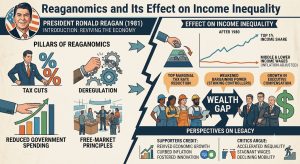
When President Ronald Reagan took office in 1981, the United States faced high inflation, slow economic growth, and rising unemployment. His administration introduced a new economic philosophy—later known as Reaganomics—built on four pillars: substantial tax cuts, deregulation, reduced growth in government spending (outside defense), and a commitment to free-market principles. Supporters credit Reaganomics with helping revive economic growth and curb inflation. Critics argue that it also marked the beginning of a sharp rise in income and wealth inequality that continues today.
The central idea behind Reaganomics was supply-side economics. The theory held that lowering taxes—especially on businesses and high-income individuals—would encourage investment, entrepreneurship, and job creation. Reagan also reduced regulations in industries such as finance, telecommunications, and energy, believing that markets allocate resources more efficiently than government.
There is little dispute that the U.S. economy recovered strongly during the 1980s. Inflation fell dramatically, GDP grew, millions of jobs were created, and the stock market expanded. These successes cemented Reagan’s reputation among supporters as the architect of a modern economic revival.
However, the gains were not shared evenly. Beginning in the early 1980s, income growth became increasingly concentrated among high-income households. Research by economists Thomas Piketty, Emmanuel Saez, Gabriel Zucman, Joseph Stiglitz, and Paul Krugman shows that the share of national income going to the top 1 percent rose substantially over the following decades, while wage growth for many middle- and lower-income workers slowed after adjusting for inflation.
Several features of Reaganomics contributed to this trend. Tax reforms sharply reduced the top marginal income tax rate, allowing high earners to retain a larger share of their income. Deregulation increased competition and efficiency but also contributed to the rapid expansion of the financial sector, where executive compensation grew much faster than average wages. The Reagan administration also took a tougher stance toward organized labor, symbolized by the dismissal of striking air traffic controllers in 1981. Union membership declined over subsequent decades, reducing workers’ bargaining power and contributing to slower wage growth for many occupations.
Still, attributing today’s inequality solely to Reaganomics would oversimplify a complex issue. Globalization exposed American workers to increased international competition. Automation and digital technologies increased demand for highly educated workers while reducing demand for many routine jobs. Educational disparities widened, and demographic changes also influenced income distribution. Policies adopted by later administrations—both Republican and Democratic—also shaped today’s economic landscape.
Supporters of Reaganomics argue that inequality is not the best measure of economic success. They emphasize that economic growth expanded opportunities, fostered innovation, and helped make the United States the world’s leading technology economy. They contend that higher rewards for entrepreneurs and investors created incentives that fueled companies such as Microsoft, Apple, Amazon, Google, and many others.
Critics counter that while innovation flourished, the benefits became increasingly concentrated. They argue that stagnant middle-class wages, rising housing costs, expensive healthcare, growing student debt, and declining economic mobility reflect structural imbalances that began in the 1980s and were reinforced over time. They advocate for more progressive taxation, stronger labor protections, greater investment in education, and expanded social safety nets to reduce inequality.
The evidence suggests that Reaganomics was neither an unqualified success nor the sole cause of America’s inequality. It helped restore growth after a difficult economic period and reshaped the role of government in the economy. At the same time, many scholars conclude that it accelerated a long-term shift toward greater income concentration by reducing tax progressivity, weakening organized labor, and relying more heavily on market outcomes.
More than four decades later, the debate over Reaganomics remains central to American economic policy. The challenge for policymakers today is not simply whether to embrace or reject Reagan’s legacy, but how to sustain innovation and economic growth while ensuring that prosperity is more broadly shared across society.