
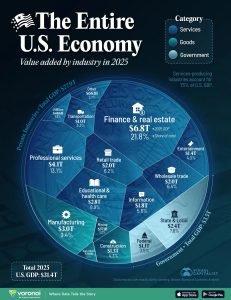
On June 3, 2026, the Visual Capitalist stated that the U.S. economy generated $31.4 trillion in GDP in 2025, making it the largest economy in the world and that “Finance, real estate, insurance, rental, and leasing led all industries at $6.8 trillion in output, accounting for more than one-fifth of the entire economy. Professional Services added another $4.1 trillion making a combination total of $10.9 trillion or 34.9% of the US economy.”
I asked AI to discuss and analyze the pros and cons of the US’s heavy dependency of these particular sectors and the following is their answer.
An economy heavily skewed toward finance and professional services—often referred to as a financialized or service-dominant economy—presents several distinct, structural vulnerabilities. When a superpower shifts its economic engine away from tangible asset production (like manufacturing and physical infrastructure) toward capital allocation and professional oversight, it faces a specific set of macro-economic, societal, and strategic headwinds.
Here are the primary downsides to a heavy reliance on finance and professional services:
1. Increased Vulnerability to Systemic Shocks (The Fragility of Intangibles)
A service- and finance-driven economy operates primarily on trust, liquidity, and asset valuations rather than physical output.
- Volatility: Financial systems are highly cyclical and prone to asset bubbles (e.g., the 2008 financial crisis). When a contraction occurs, wealth built on leverage and paper valuations can evaporate overnight, creating severe cascading effects across the entire economy.
- Lack of a “Floor”: Unlike manufacturing or agriculture, which have a baseline value tied to physical human needs (goods, food, equipment), financial products and consulting services can see demand drop to near-zero during a deep crisis, leaving fewer physical economic anchors to stabilize the system.
2. The Acceleration of Domestic Wealth Inequality
Finance and advanced professional services (such as corporate law, elite consulting, and tech-adjacent service sectors) are inherently “super-star” industries.
- Geographic and Social Concentration: These sectors disproportionately reward highly educated workers concentrated in specific urban hubs (e.g., New York, London, San Francisco). This creates acute regional imbalances, leaving industrial or rural heartlands underfunded and economically hollowed out.
- Capital vs. Labor: Financialization tends to prioritize shareholder value over long-term capital expenditure and labor compensation. When corporate profits are driven more by financial engineering (like stock buybacks and corporate restructuring) than by product innovation, the returns to capital vastly outpace the returns to wages, worsening wealth stratification.
3. The “Execution Gap” and Loss of Technical Capability
When the smartest minds and the majority of capital flow into finance and consulting, the nation’s physical engineering and manufacturing competencies suffer from a massive talent and resource drain.
- Brain Drain: Instead of pursuing breakthroughs in material sciences, advanced hardware manufacturing, or physical infrastructure, top-tier engineering and analytical talent is frequently routed into quantitative finance, corporate law, or high-level strategic management.
- The Execution Gap: This creates a mismatch where a country retains world-class capacity for ideation and strategic planning, but suffers from tactical chaos and an inability to physically execute. Building factories, scaling production lines, and maintaining infrastructure become slower, more expensive, and less efficient because the baseline domestic industrial ecosystem has eroded.
4. Strategic Vulnerability and Geopolitical Exposure
Depending heavily on services means relying on foreign partners to build, refine, and ship physical goods.
- Supply Chain Leverage: In a geopolitical crisis, a service-based economy faces asymmetric vulnerabilities. While financial sanctions and frozen capital are potent weapons, they can be countered by adversaries who control the physical bottlenecks of global production—such as critical minerals, semiconductors, and heavy industrial manufacturing capacity.
- The Attrition Problem: In extended global competitions, the capacity to rapidly scale physical production (ships, energy infrastructure, medical supplies, or defense matériel) often outlasts the capacity to manipulate capital markets. A country that cannot manufacture its own vital components possesses a strategic vulnerability that finance cannot easily patch.
5. “Dutch Disease” of the Talent Market
In economics, Dutch Disease typically refers to a resource boom hollowing out other sectors of the economy. A similar phenomenon occurs with finance and corporate services. Because these sectors generate extraordinarily high profit margins per employee, they artificially inflate the cost of living in economic centers and drive up the reservation wage for high-skilled talent. This makes it difficult for lower-margin, capital-intensive sectors—like domestic manufacturing, public infrastructure, and hardware R&D—to attract the investment and talent they need to remain globally competitive.
Summary
While finance and professional services generate immense high-margin wealth and project incredible global influence via capital markets, they do not distribute prosperity evenly, nor do they build physical resilience. The core risk for the US is a hollowed-out domestic baseline—leaving the nation highly capable of structuring deals and designing strategies, but structurally dependent on foreign powers for the physical realities of survival and industrial competition.