
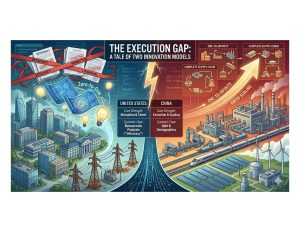
America Invents, China Deploys: The AI Race May Be Decided by Who Can Scale
For years, discussions about technological competition between the United States and China have been framed around a simple question: Who innovates better?
The long-standing assumption has been that the United States invents while China merely imitates. While that narrative may have held some truth twenty years ago, today it is increasingly outdated.
A more useful framework for understanding the emerging artificial intelligence competition is the structural distinction between 0 to 1 and 1-N implementation.
The Two Mechanics of Technological Power
The global tech race is no longer a monolith. It is divided into two distinct phases, and both superpowers excel at different halves of the equation.
1. United States: The 0 to 1 Innovation Machine
The United States remains arguably the world’s greatest engine for pure invention. Powered by Silicon Valley, a robust venture capital ecosystem, world-class research universities, and a culture that rewards high-risk risk-taking, the U.S. has produced an extraordinary stream of foundational breakthroughs:
-
The Internet & GPS
-
The Microprocessor
-
Modern Cloud Computing
-
Advanced Frontier AI Models
When it comes to creating entirely new technological paradigms, no country has consistently matched the United States. But innovation is only half the story.
2. China: The 1 to N Implementation Engine
The harder, less glamorous challenge is often 1 to N implementation—the process of taking a breakthrough and systematically deploying it across an entire economy. This is where China has quietly become one of the most formidable forces in modern history.
Consider the historical precedent of how China scales existing technologies:
| Technology | Invention Origin | China’s Scale & Execution |
| High-Speed Rail | Europe / Japan | Built the world’s largest high-speed rail network. |
| Electric Vehicles | United States / Europe | Became the world’s dominant EV producer and market. |
| Solar Power | United States | Manufactures the vast majority of the world’s solar panels. |
Again and again, China has demonstrated an extraordinary ability to take an existing technology and scale it with unmatched speed, state coordination, and persistent capital.
Why Implementation Trumps Invention
The distinction between creating and scaling matters because economic and geopolitical power is rarely determined by invention alone. History is filled with examples where the inventor captured prestige, while the implementer captured the actual market.
A scientific breakthrough sitting in a laboratory generates little economic value. A technology embedded across millions of factories, offices, hospitals, and transportation systems transforms an entire society.
This reality is especially relevant in the age of artificial intelligence. Much of today’s AI debate focuses on model rankings, benchmark scores, and which company released the most capable large language model (LLM). These are important measures of frontier progress, but they may not be the ultimate metrics of macroeconomic impact.
The decisive question is: What happens after the model is built?
-
Can AI be deeply integrated into heavy manufacturing systems?
-
Can it optimize complex, real-world logistics networks?
-
Can it accelerate commercial scientific discovery and engineering workflows?
-
Can it autonomously manage power grids, transportation systems, and supply chains?
The nation that successfully deploys AI across its real economy may ultimately benefit far more than the nation that merely develops the smartest standalone model.
The Asymmetry of National Execution
This structural shift creates an uncomfortable reality for American policymakers: What good is building the world’s best AI model if it never meaningfully transforms the physical industries that generate national wealth?
The American Bottleneck
The United States still possesses extraordinary strengths. It leads in frontier AI research, venture capital, advanced semiconductor design, and global tech branding. However, America frequently struggles with the long, grinding process of physical implementation:
-
Regulatory & Administrative Delays: Major infrastructure projects face years of bureaucratic red tape.
-
Political Polarization: Short election cycles make cohesive, long-term industrial strategy incredibly difficult.
-
Financial Incentives: Public markets frequently reward quarterly stock performance over decade-long capital investment horizons.
In short: The United States excels at creating the future, but often struggles to build it.
The Chinese Convergence
China faces its own macroeconomic challenges, but strategic patience is not one of them. Its political and economic systems are highly optimized for long-term execution:
-
Infrastructure can be built rapidly without protracted legal delays.
-
Industrial policy can be strictly coordinated across multiple levels of government.
-
Strategic sectors receive sustained, state-backed financial support over decades.
Most importantly, China is no longer merely a scaling machine. The old stereotype that Chinese firms only copy technology has become detached from reality. Chinese researchers are now driving genuine, frontier innovation in batteries, telecommunications, commercial drones, ultra-high-voltage power grids, and increasingly, AI itself.
China is rapidly becoming capable of both 0 to 1 innovation and 1 to N implementation.
Conclusion: Industrializing the Algorithm
The future AI race may not be won by whoever builds the smartest chatbot. It will likely be won by whoever successfully embeds artificial intelligence into the structural bedrock of society—its factories, infrastructure, logistics networks, and scientific institutions.
In other words, the decisive question may not be who invents artificial intelligence, but who industrializes it.
If that proves true, the AI competition will be less a contest of algorithms and more a contest of national execution. And in the historical battle between invention and implementation, implementation often matters far more than innovators care to admit.