
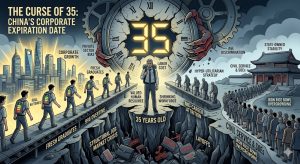
The “Curse of 35”: China’s Corporate Expiration Date
The “Curse of 35” (35 sui mozhou) is one of the most glaring contradictions in China’s current economy. While the central government is progressively delaying the statutory retirement age to cope with a shrinking population, the private sector is actively shedding white-collar workers at age 35, treating them as if their professional shelf-life has expired.
Understanding why corporate China enforces this deadline reveals a calculated, hyper-utilitarian labor strategy and a major structural crisis in the job market.
Why Companies Drop Workers at 35
The decision to force out or refuse to hire workers over 35 is rarely about a lack of competence. Instead, it is driven by an economic calculation summarized by a popular workplace phrase:
“Valued as a human resource before 35; seen as a labor cost after.”
1. The Economics of “Fresh Chives” and Full Batteries
China’s tech and corporate sectors are heavily built on the back of brutal overtime cultures like “996” (9 AM to 9 PM, 6 days a week).
-
Energy Levels: Workers in their 20s are viewed as having “full batteries.” They can pull all-nighters, handle extreme stress, and have fewer personal obligations.
-
The Infinite Supply: With over 12 million university graduates entering the market annually, labor is highly fungible. Tech insiders often refer to young coders and corporate hands as “chives” (jiucai)—cheap, abundant, and easily replaced when harvested. A 22-year-old graduate will work twice the hours of a 35-year-old for half the pay.
2. The Liability of Family and Health
By age 35, life inevitably catches up. Workers marry, have children, and need to care for aging parents.
-
The Anti-Overtime Penalty: Corporate managers view these family milestones as liabilities. A worker who needs to pick up a child from school or goes home to a spouse cannot easily participate in “performative overtime”—the practice of sitting at a desk until midnight just to show deference to the boss.
-
The Physical Toll: A decade of 996 takes a physical toll. By 35, many workers face burnout, chronic fatigue, or health issues, making them less willing to sacrifice their lives for the company.
3. The Management Paradox
In flat corporate structures, a 35-year-old worker who has not made it into middle or upper management becomes an awkward presence.
-
Generational Friction: Managers—who are often in their late 20s or early 30s themselves—frequently find it difficult or uncomfortable to supervise older subordinates.
-
Loss of Compliance: Older employees have institutional memory, know labor laws, and are less susceptible to corporate gaslighting. They are harder to manage than a compliant, anxious 22-year-old fresh out of school.
How This Impacts the Corporate Job Market
The “Curse of 35” creates a severe ripple effect across the entire economic ecosystem, driving high anxiety and altering the shape of the workforce.
   [Brutal Overtime / 996]
              │
              ▼
 [Burnout & Family Focus at 35]
              │
              ▼
    [Layoff / Age Bias]
              │
              └──────────────────────────────┐
                                             ▼
                              ┌──────────────────────────────┐
                              │ The Corporate Ripple Effects │
                              └──────────────────────────────┘
                               • Severe Mid-Career Attrition
                               • High Educational Waste
                               • Hyper-Anxiety Cycle (Age 28+)
                               • Civil Service Bottleneck
1. Chronic Mid-Career Attrition and Talent Drain
The corporate market effectively discards workers at the peak of their practical experience. Decades of specialized institutional knowledge are traded for short-term cost savings. This creates a workforce that is highly energetic but structurally shallow, lacking the seasoned oversight needed to prevent expensive technical or managerial mistakes.
2. Chronic Panic Starting at Age 28
The timeline for anxiety has compressed. Young professionals no longer wait until 35 to stress; the panic begins around age 28 or 30. Workers view their careers not as long-term journeys, but as a high-speed sprint where they must secure enough wealth to survive the inevitable post-35 cliff.
This deepens the cultural retreat into “tangping” (lying flat)—if the corporate ladder snaps at 35, why exhaust yourself climbing it?
3. The Collapse of Consumer Confidence
The 35-year-old demographic is traditionally a society’s primary consumer engine—the group that buys homes, purchases vehicles, raises children, and drives the retail economy. Knowing that job security disappears precisely during these prime spending years causes young families to aggressively hoard cash. This structural anxiety acts as a massive drag on domestic consumption, complicating Beijing’s goal of transitioning to a consumption-led economy.
4. Overcrowding the “Iron Rice Bowl”
Because the private sector is seen as a ticking clock, the rush toward state-backed security has become unprecedented. Millions of young people compete for civil service positions, public school teaching tracks, and roles at State-Owned Enterprises (SOEs) where employment is stable.
Signs of Policy Shift: Recognizing that this bias is a major economic vulnerability, the Chinese government has taken symbolic steps to fight ageism. For the national civil service exams, Beijing recently relaxed the traditional strict hiring cap, raising the age limit to 38 for general applicants, and up to 43 for those holding master’s or doctoral degrees.
While the state is trying to lead by example, private tech, finance, and manufacturing firms have been slow to follow suit. As long as the supply of overqualified young graduates remains high, private corporations continue to treat age 35 not as a milestone of maturity, but as an expiration date.