
America’s Economy Is Growing. Its Middle Class Is Not.
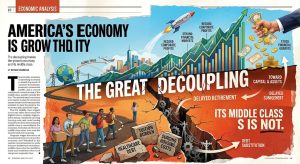
For decades, the United States sold a powerful economic promise: if the economy grew, ordinary Americans would rise with it.
That promise is weakening.
By conventional metrics, the U.S. economy remains extraordinarily successful. Corporate profits are strong, financial markets repeatedly hit record highs, and the country continues to dominate global finance and technological innovation.
Yet beneath those headline numbers lies a widening disconnect: the middle class is no longer advancing at the same pace as the economy itself.
Since the late 1970s, productivity has risen dramatically while wage growth for typical workers has lagged behind. America produces more wealth than ever, but a growing share of that wealth flows toward capital and assets rather than wages.
At the same time, the costs that define middle-class life have surged.
Housing prices have outpaced incomes in many regions. Healthcare consumes an ever-larger share of household budgets. College tuition, once manageable, now burdens millions with long-term debt.
The result is a structural squeeze: incomes rise slowly while the cost of stability rises faster.
For much of the twentieth century, productivity gains translated into broad improvements in living standards. A single income could often support a family, buy a home, and build retirement security.
Today, many households require two incomes simply to remain financially stable. Debt increasingly substitutes for wage growth, and retirement is delayed for economic reasons rather than personal choice.
Meanwhile, the gains of the modern economy are concentrated heavily in financial assets. The stock market continues to surge, but ownership of equities is concentrated among upper-income households. For much of the population, wages remain the primary source of survival—and wages have struggled to keep pace with modern costs.
Perhaps the clearest sign of this shift is declining upward mobility. Americans born in the 1940s were overwhelmingly likely to earn more than their parents. For those born in the 1980s, that probability has fallen sharply.
This is not an economy in collapse. It is an economy in divergence.
The American system remains highly effective at generating aggregate growth. What it struggles to do is distribute the benefits broadly enough to preserve middle-class security.
Increasingly, Americans live in two separate economies: one driven by assets and capital appreciation, the other defined by wages, debt, and rising living costs.
Other countries have made different trade-offs. Many European economies accept slower growth in exchange for stronger social protections and lower household volatility. China has pursued a more state-directed model centered on infrastructure, industrial policy, and long-term planning.
Neither model is flawless. But both highlight a question the United States has largely avoided:
Is the purpose of an economy simply to maximize growth—or to sustain broad-based stability?
For decades, America managed to do both. Today, it increasingly excels at only one.
The political consequences are already visible in rising distrust, polarization, and populist anger. Societies rarely fracture because they stop producing wealth. They fracture when large segments of the population no longer feel connected to the prosperity being produced.
America is not experiencing economic collapse.
It is experiencing economic decoupling.
The economy continues to grow.
Its middle class no longer grows with it.