
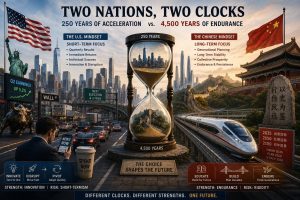
Two Nations, Two Clocks
The rivalry between the United States and China is usually framed in terms of trade, technology, or military power. But the deeper divide may be historical consciousness itself.
The United States is a nation roughly 250 years old. China is a civilization with around 4,500 years of recorded continuity.
That difference shapes how each country understands time, risk, and survival.
America rose rapidly during an era of expansion, industrialization, and global dominance. Its culture became optimized for speed, disruption, and reinvention. Americans are conditioned to believe problems can be solved quickly and that the future belongs to those who innovate first.
This mindset produced extraordinary achievements:
- Silicon Valley,
- the internet,
- aerospace leadership,
- and a powerful entrepreneurial culture.
But it also encouraged short-term thinking. American politics revolves around election cycles, corporations around quarterly earnings, and media around hourly outrage. The system rewards immediate performance more than generational planning.
China developed under very different historical conditions.
For centuries, Chinese civilization endured dynastic collapse, invasion, famine, civil war, and reunification. Yet the civilization survived. That long historical memory created a political culture deeply focused on continuity, stability, and endurance.
Modern China often plans in decades rather than quarters. Infrastructure, education, industrial policy, and technological development are treated as long-term national projects. Temporary hardship is viewed differently when a civilization measures itself across millennia instead of election cycles.
This helps explain why China emphasizes:
- strategic patience,
- infrastructure,
- savings,
- education,
- and state coordination.
The contrast can be understood as two different relationships with time.
America behaves like a young power:
- fast-moving,
- experimental,
- innovative,
- and impatient.
China behaves more like an old civilization:
- cautious,
- strategic,
- resilient,
- and long-term oriented.
Neither model is inherently superior.
America’s dynamism generates creativity and breakthrough innovation. Its decentralized system allows reinvention and adaptation. But excessive short-termism can weaken social cohesion, infrastructure, and long-term planning.
China’s long-term orientation creates strategic coherence and national continuity. But systems built around stability can also become rigid and resistant to dissent or experimentation.
In many ways, each country possesses the qualities the other increasingly lacks.
The real competition between the United States and China may therefore not simply be economic or military. It may be a contest between two civilizational models:
- one optimized for acceleration,
- the other for endurance.
The larger question is not which country is “winning” today, but which system can better balance innovation with stability, speed with patience, and present success with long-term survival.
History suggests civilizations rarely decline from lack of wealth alone. They decline when short-term incentives overpower long-term resilience.
The United States and China are ultimately operating on two different historical clocks — and the 21st century may reveal which clock is better suited for a turbulent world.