
America Can’t Have It Both Ways: Why Protectionism Undermines the Post-Industrial Dream
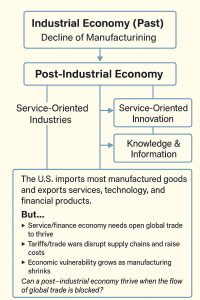
As the U.S. has shifted from a manufacturing powerhouse to a high-tech, service, and financial economy, it has grown deeply dependent on global supply chains for basic goods 3,7. This post-industrial model works only as long as international trade flows freely and essential imports remain affordable. However, recent U.S. trade policy—marked by sweeping tariffs and protectionist measures—now threatens the very foundation of this economic strategy 1,2.
The Post-Industrial Contradiction
- The U.S. economy thrives on exporting services and intellectual property while importing manufactured goods made more cheaply abroad 3. This arrangement keeps consumer prices low and allows American firms to focus on high-value sectors.
- Tariffs and trade wars disrupt these flows, raising costs for businesses and consumers, and causing inflation and supply chain headaches 1,2. Protectionist policies intended to revive domestic manufacturing have largely failed to deliver promised job gains, while harming downstream industries and overall economic efficiency 1.
Global Influence at Risk
- America’s unilateral tariffs have strained alliances, prompted retaliation, and undermined trust in U.S. leadership 1. Close partners are seeking alternatives, and the global trading system is fragmenting, reducing the U.S.’s ability to shape international economic rules 1.
- The retreat from multilateralism and the rules-based order has led to market volatility, weakened the dollar, and diminished America’s soft power 1.
The Bottom Line
The U.S. cannot sustain a prosperous post-industrial economy while simultaneously restricting the import of goods it no longer produces. Free trade is essential for the service and financial sectors to flourish. Protectionism may offer short-term political gains, but it creates long-term vulnerabilities, higher costs, and a diminished role on the world stage 1,2,3.
In short:
America can’t have it both ways. To remain a global economic leader, the U.S. must choose: open markets and post-industrial prosperity, or protectionism and relative decline.
-
- https://www.norwich.edu/topic/all-blog-posts/america-first-trade-policy-knowable-and-unknowable-consequences
- https://www.epi.org/publication/the-u-s-approach-to-globalization-has-gone-from-bad-to-worse-under-trump-how-to-construct-a-progressive-policy-agenda-instead/
- https://michael-hudson.com/2023/11/understanding-americas-post-industrial-economy/
- https://www.nationalaffairs.com/publications/detail/industrial-policy-right-and-wrong
- https://www.cfr.org/article/curse-nostalgia-industrial-policy-united-states
- https://www.industryweek.com/the-economy/public-policy/article/22007271/debunking-the-post-industrial-myth
- https://www.theamericanconservative.com/the-post-industrial-economy-failed/
- https://hbr.org/2012/03/shattering-the-myths-about-us-trade-policy
- https://www.cfr.org/blog/post-industrial-economy
- https://www.industryweek.com/the-economy/trade/article/21245772/how-the-us-economy-lost-its-independence-and-workers-their-livelihood