
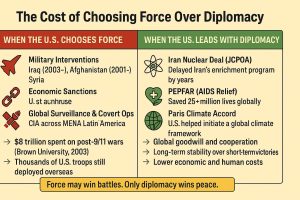
In a world where power is increasingly diffused and interdependence shapes every major conflict, the United States continues to wield military force and economic coercion as its primary tools of foreign policy. From the Middle East to East Asia, from economic sanctions to drone strikes, Washington often defaults to hard power even when soft power—or simple diplomacy—would better serve its long-term interests.
The tragedy is not that the U.S. is unaware of the consequences. It is that even as American leaders recognize that they cannot solve the world’s problems alone or through force, they remain trapped in a system that rewards confrontation over compromise. The result is a cycle of blowback that weakens American influence, drains national resources, and deepens global instability.
A Costly Addiction to Power
The roots of this pattern go back to the post-Cold War period, when the U.S. emerged as the world’s sole superpower. That “unipolar moment” shaped a generation of policymakers who came to believe that American leadership was not only necessary, but unchallengeable. This belief—sometimes called American exceptionalism—has led to a foreign policy posture that conflates strength with dominance and diplomacy with weakness.
As a result, the U.S. often chooses sanctions over dialogue, threats over negotiation, and military buildup over regional diplomacy. In Iraq, Afghanistan, Iran, and now in the escalating tensions with China, these choices have not solved the underlying problems. Instead, they have created new ones—empowering adversaries, alienating allies, and exposing the limits of American control.
Domestic Politics Over Strategic Restraint
Part of the problem lies in America’s own political incentives. In Congress and on the campaign trail, it is politically safer to appear “tough” than to advocate for patience or restraint. Supporting Israel, sanctioning Russia, or escalating rhetoric against China earns bipartisan applause—even if those actions bring the U.S. no closer to peace or stability.
Meanwhile, the foreign policy establishment—sometimes derisively called “the Blob”—is deeply invested in the machinery of American hegemony: global military bases, arms sales, defense pacts, and intelligence networks. These institutions are built for confrontation, not collaboration, and shifting away from them means confronting powerful interests.
Blowback Is Real—and Growing
The costs of this approach are no longer theoretical. Every new deployment, every fresh round of sanctions, brings with it economic, diplomatic, and strategic blowback. In the Middle East, U.S. actions have fueled regional proxy wars that endanger allies and U.S. troops alike. In East Asia, efforts to contain China have led to trade disruptions that hurt American consumers and manufacturers. And in the Global South, Washington’s double standards—supporting Ukraine’s sovereignty while ignoring Palestinian suffering—are undermining America’s credibility.
More fundamentally, the world has changed—but U.S. strategy has not. Power is now multipolar, and influence is earned through cooperation, not imposed through force. Climate change, global pandemics, and economic volatility require multilateral solutions, yet America too often arrives at the table with a clenched fist instead of an open hand.
The Path Forward
It doesn’t have to be this way. The United States still possesses unmatched diplomatic talent, global alliances, and soft power assets. But it must be willing to lead through persuasion rather than coercion. That means investing in the State Department as much as the Pentagon. It means listening to rivals as well as allies. And it means accepting that American leadership must now be earned, not assumed.
If the U.S. wants to preserve its influence in the 21st century, it must abandon the illusion of invulnerability. Diplomacy is not a sign of weakness—it is a prerequisite for real strength in an interconnected world.
Until Washington internalizes that lesson, it will continue to fight battles it cannot win, lose allies it cannot afford, and hurt itself in the name of power it no longer holds alone.