
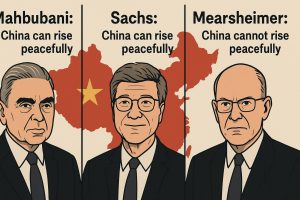
The debate over China’s rise is sharply divided among leading thinkers. While Kishore Mahbubani and Jeffrey Sachs argue that China can ascend peacefully within the global order, John Mearsheimer contends that conflict with the United States is inevitable. This article attempts to summarize their divergent views, highlighting the philosophical, strategic, and geopolitical assumptions that shape their conclusions.
1. Nature of International Politics
- Mearsheimer: Structural realist — believes great power rivalry is inevitable. Rising powers always clash with existing hegemons.
- Mahbubani & Sachs: More optimistic — believe conflict is not preordained, and peaceful coexistence is possible with wise diplomacy.
2. View of the U.S. Role
- Mearsheimer: The U.S. must contain China to maintain dominance, even if that increases the risk of war.
- Mahbubani: The U.S. should accept multipolarity and avoid provoking unnecessary conflict.
- Sachs: The U.S. is often the aggressor, driven by military-industrial interests rather than real threats.
3. View of China’s Intentions
- Mearsheimer: China will seek regional hegemony and cannot be trusted to remain status quo.
- Mahbubani: China is more focused on economic development than dominance.
- Sachs: China’s rise is not imperialistic, and it’s wrong to project U.S.-style ambitions onto it.
4. Policy Prescription
- Mearsheimer: Advocate for containment, alliances, and deterrence to block China’s rise.
- Mahbubani: Call for engagement, reform of global institutions, and mutual respect.
- Sachs: Recommend cooperation on global issues (climate, poverty) and non-militarized diplomacy.
In essence:
- Mearsheimer sees power struggle as destiny.
- Mahbubani believes peaceful rise is possible with humility and reform.
- Sachs believes the U.S. should stop acting like a paranoid empire and prioritize shared global interests.
While Mearsheimer predicts an almost deterministic path toward conflict, Mahbubani and Sachs argue that choices made by leaders and the embrace of cooperation can steer the world away from such a tragic outcome. The ongoing trajectory of US-China relations will continue to test the validity of these contrasting perspectives.