
From Silicon Valley to Shanghai, leaders of Chinese descent are quietly shaping the technologies—and geopolitics—of the future.
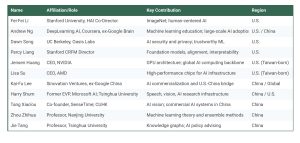
As the race for artificial intelligence dominance intensifies between the United States and China, one underreported truth stands out: some of the most pivotal architects of this technological revolution hail from a shared cultural heritage. Across academia, industry, and infrastructure, leaders of Chinese descent are not just participants in the AI era—they are defining it.
In Silicon Valley, Fei-Fei Li, the Stanford professor behind ImageNet, helped catalyze the deep learning boom that reshaped modern computer vision. Andrew Ng, a co-founder of Google Brain and Coursera, has become one of the world’s most recognizable educators in machine learning. Alongside them, researchers like Dawn Song and Percy Liang are leading efforts to make AI systems safer, more ethical, and more interpretable.
Just as critical—but often overlooked—are the figures behind AI’s physical backbone. Jensen Huang, the Taiwan-born CEO of NVIDIA, turned his company’s graphics chips into the gold standard for training AI models. His cousin, Lisa Su, leads AMD and has spearheaded its resurgence with high-performance chips that power cloud computing across the globe. Together, they’ve provided the silicon behind the semantics.
Meanwhile in China, tech luminaries like Kai-Fu Lee, Tang Xiao’ou, and Harry Shum have built robust AI ecosystems—pushing advances in facial recognition, smart cities, and AI entrepreneurship. Many of these leaders were educated in the U.S. or worked abroad before returning to shape China’s domestic AI agenda.
Their stories complicate the narrative of a binary U.S.–China rivalry. These innovators span borders, speak both technical and cultural languages, and demonstrate that AI is not the product of one nation, but of a global web of talent and ambition.
As the world navigates the promises and perils of artificial intelligence—from data governance to geopolitical competition—the role of Chinese-descended scientists, engineers, and executives is indispensable. They remind us that the future of AI will not be built solely in code or chips, but in the courage to bridge divides—between East and West, between machines and meaning.